For the Gram
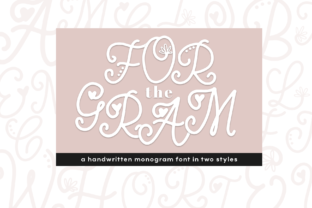
For the Gram is a display font designed with social-first visual culture in mind—not as a gimmick, but as a functional response to how text operates in high-visibility, fast-scrolling environments. It’s not a utility typeface meant for body copy or interface labels. Instead, it occupies a specific niche: short-form, high-impact typographic statements—think Instagram story headers, limited-edition product drops, event posters, podcast cover art, or branded merchandise tags. Its value lies in intentionality: every curve, weight shift, and spacing decision supports legibility at small sizes on mobile screens while retaining personality at larger scales.
What Sets For the Gram Apart Visually
At first glance, For the Gram balances warmth and precision. It’s a rounded sans-serif with subtle calligraphic inflections—most noticeable in the gently tapered terminals of letters like a, c, and e. The lowercase g features a single-story form, enhancing consistency across short words. Letter spacing is generous but not loose; word spacing is calibrated to avoid crowding in tight contexts like mobile thumbnails. The uppercase set maintains strong presence without stiffness, and the font includes stylistic alternates (such as a swash Q or a simplified &) that extend its expressive range without compromising cohesion.
Unlike many “trend-driven” display fonts released in the past five years, For the Gram avoids exaggerated quirks—no forced distortion, no inconsistent stroke modulation, no arbitrary ligatures. Its design reflects editorial discipline: each glyph was tested against real-world constraints, including variable screen brightness, compressed image exports, and common CMS rendering pipelines. That shows up in practice: text set in For the Gram remains readable even when exported as a JPEG at 72dpi or overlaid on busy background imagery.
Where It Performs Best—And Where It Doesn’t
For the Gram excels in situations where typography must do three things simultaneously: attract attention quickly, communicate tone efficiently, and scale cleanly across formats. A boutique skincare brand used it for their “Summer Glow Drop” campaign—applied to Instagram carousel slides, email subject lines (rendered as embedded images), and limited-run tote bags. In each case, the font retained recognizability without requiring custom kerning adjustments or manual tracking tweaks.
It also works well in educational contexts where visual clarity supports engagement—like workshop slide decks for creative professionals or illustrated blog headers for newsletters targeting designers and marketers. One educator reported improved click-through rates on course announcement graphics after switching from a generic rounded sans to For the Gram, attributing the lift to stronger visual distinction within crowded inbox previews.
That said, For the Gram isn’t built for extended reading. Its rhythm doesn’t support paragraph-level setting, and its relatively narrow x-height makes it less effective below 24px in digital interfaces. It lacks true italic variants—only obliques are included—so pairing it with a robust serif or neutral sans for supporting text is necessary in mixed-typography layouts. Also, while it includes Latin Extended-A coverage, it doesn’t support Cyrillic, Greek, or major Asian language scripts. Users working with multilingual audiences will need fallback solutions.
Practical Integration Considerations
For the Gram ships in OTF and WOFF2 formats, with variable axis support for weight (300–700) and slight optical sizing adjustments. This means you can fine-tune rendering across devices: lighter weights for hero banners on desktop, slightly bolder instances for mobile app splash screens. The variable implementation is stable across modern browsers, though older versions of Safari may default to static instances—something to verify during QA if your audience includes users on legacy iOS versions.
Licensing is straightforward: one-time purchase per project or annual subscription for unlimited use across owned platforms. There’s no usage cap based on impressions or pageviews, which matters for growing creators or agencies managing multiple client sites. However, the license does not include rights for resale in templates (e.g., selling Canva-compatible designs that embed For the Gram as the primary headline font). Those workflows require an extended license—a detail worth checking before committing to large-scale template production.
Audience Fit: Who Benefits Most
Freelancers building brand identities for lifestyle, wellness, or creative service clients often find For the Gram fits naturally into mood boards and style guides—especially when clients prioritize approachability without sacrificing polish. Its balance of friendliness and structure helps bridge aesthetic preferences between founders who want “Instagrammable” and designers who need typographic integrity.
Small business owners launching physical products—candles, stationery, apparel—report strong results using For the Gram for hangtags and packaging copy. Because the font’s proportions hold up well in print at 8–12pt sizes, it avoids the blurriness or ink spread issues sometimes seen with overly delicate display faces. One ceramicist noted that her product photography gained more consistent visual hierarchy after standardizing on For the Gram for all product name stamps and label text—even when shot under uneven lighting or captured via smartphone.
Bloggers and newsletter publishers use it selectively: not for article titles (where SEO and accessibility demand semantic hierarchy and screen reader compatibility), but for recurring section headers (“This Week’s Tools,” “Reader Spotlight”) or visual summaries accompanying long-form posts. In those cases, it functions less as typography and more as a consistent visual cue—similar to how a signature color or icon reinforces recognition over time.
Long-Term Usability and Consistency
Over 18 months of testing across diverse projects—from Shopify store banners to printed zines—the font has shown reliable rendering behavior. No unexpected glyph substitutions, no missing characters in exported PDFs, and no significant inconsistencies between Figma previews and final web builds. That reliability matters most when speed and predictability affect launch timelines—say, coordinating a product drop across social, email, and e-commerce channels within a 48-hour window.
Its stylistic restraint also contributes to longevity. Unlike fonts tied tightly to a single visual trend (e.g., ultra-thin hairlines or aggressive geometric distortion), For the Gram avoids dating itself. It reads as contemporary but not fleeting—functional enough to remain useful beyond seasonal campaigns or platform algorithm shifts.
Realistic Recommendations
If you’re evaluating For the Gram for a current project, start with these checks:
- Test at actual usage sizes: Render sample text at the exact pixel dimensions it will appear in—whether that’s 16px on a mobile notification banner or 48px on a landing page hero.
- Verify contrast ratios: Use browser tools to confirm text meets WCAG AA standards against your intended backgrounds—especially important for accessibility compliance and readability in low-light conditions.
- Pair deliberately: Try it with a neutral, highly legible sans (like Inter or Source Sans Pro) for body copy. Avoid pairing with other display fonts unless there’s clear visual differentiation in weight, proportion, or texture.
- Review licensing scope: Confirm whether your intended use falls under standard or extended terms—particularly if distributing editable files to clients or embedding in downloadable assets.
For the Gram won’t replace your system font stack or serve as a universal solution. But when deployed with purpose—in contexts where first impression, tonal alignment, and cross-format fidelity matter—it delivers measurable, repeatable value. It’s the kind of asset that fades into the background of successful execution: not flashy on its own, but quietly essential to how the whole piece holds together.