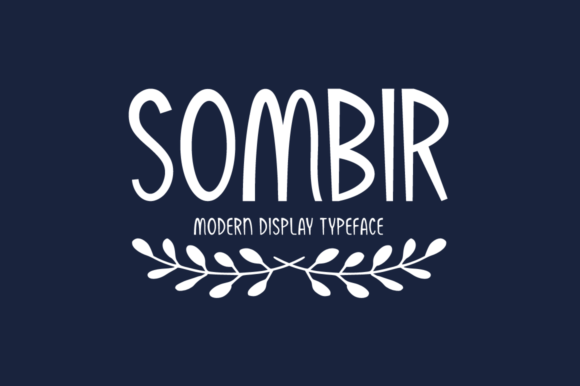
Sombir: A Display Font That Feels Human in a Digital World
Typography is no longer just about legibility—it’s about resonance. In an era where attention is fragmented, interfaces are increasingly automated, and brand voices compete for authenticity, the fonts we choose carry quiet but unmistakable weight. Sombir stands out not because it shouts, but because it breathes: a simple, yet classic display font with an adventurous and organic vibe. Its letterforms balance structure and spontaneity—slight irregularities in stroke weight, gentle asymmetry in terminals, and a rhythm that feels hand-guided rather than algorithmically smoothed. It doesn’t try to be everything; it excels where many modern typefaces hesitate: in moments of emphasis, identity, and intention.
Why Sombir Fits Right Now—Without Trying Too Hard
Design trends have swung away from rigid minimalism toward what might be called “thoughtful imperfection.” Think of the resurgence of tactile textures in UI design, the preference for analog-inspired photography in social feeds, or the rise of brands that lead with warmth over polish. Sombir lands precisely in this cultural current—not as a reaction, but as a quiet alignment. It doesn’t mimic handwriting, nor does it lean into retro clichés. Instead, its organic vibe emerges through subtle, consistent choices: a slightly uneven baseline pulse, open counters that invite air, and terminals that taper like ink pulled across paper. These aren’t flaws—they’re cues that signal care, craft, and human presence.
This matters because users—whether scrolling a portfolio site, reading a newsletter, or evaluating a product landing page—are subconsciously attuned to signals of authenticity. A font like Sombir supports that without demanding attention. It works especially well in contexts where clarity meets character: podcast episode titles, book cover typography, workshop branding, or even the hero text on a small business homepage. It’s not meant for body copy, and it doesn’t pretend to be. Its role is intentional, focused, and expressive—exactly what modern communication often lacks.
From Static Logos to Living Brand Systems
Brands today rarely live in one place. A logo appears on a mobile app, a printed brochure, a video thumbnail, and a conference banner—all within the same week. That means display typography must be flexible enough to hold meaning across scales and surfaces, yet distinct enough to remain recognizable. Sombir’s balanced proportions and generous x-height give it unusual versatility for a display face. At 48px on a retina screen, its details read clearly. At 120px on a large-format print, its organic rhythm becomes a visual anchor—not overwhelming, but grounding.
Consider how a freelance educator might use Sombir: in the title slide of a workshop deck, paired with a clean sans-serif for supporting text. Or how a sustainable skincare brand could apply it to ingredient callouts on packaging—its warmth reinforcing values like transparency and care. These aren’t decorative flourishes; they’re strategic tonal decisions. Sombir doesn’t replace functional typography—it elevates it, offering contrast that clarifies hierarchy and deepens emotional connection.
How Creators Are Using Sombir—Beyond the Obvious
Practically speaking, Sombir thrives where intentionality matters most. Designers aren’t using it for headlines alone. Some are layering it thoughtfully in motion graphics—animating letter spacing to echo natural speech cadence. Others pair it with variable sans-serifs (like Inter or Manrope) to create dynamic, responsive typographic systems that shift tone without sacrificing cohesion. One illustrator uses Sombir for chapter titles in her self-published zine, then traces over select letters by hand to bridge digital and physical expression—a nod to the font’s inherent adaptability.
For marketers and content creators, Sombir offers a low-risk way to differentiate. In email subject lines rendered as images (where web fonts don’t load), its strong silhouette remains legible and memorable. On Instagram carousels, it holds up against busy backgrounds better than ultra-thin or overly geometric alternatives. And because it avoids trend-driven extremes—no exaggerated contrast, no forced distortion—it ages gracefully. A campaign built around Sombir today won’t feel dated in 18 months.
Realistic Pairings That Work—Without Overcomplicating
Typography pairing isn’t about rules—it’s about contrast with continuity. Sombir pairs best with typefaces that offer structural clarity without competing for attention. Here’s what practitioners consistently report working:
- With neutral sans-serifs: Fonts like Lato, Nunito, or IBM Plex Sans provide reliable readability in body text while letting Sombir shine in headings—no stylistic clash, just clear visual hierarchy.
- In editorial layouts: When used for pull quotes or section dividers alongside serif body text (e.g., Literata or Charter), Sombir adds punctuation—not noise.
- In interface accents: Not for buttons or navigation, but sparingly—as status labels (“New,” “Limited,” “Live”)—where its organic vibe conveys immediacy and humanity.
What doesn’t work? Overly decorative companions, ultra-narrow or ultra-bold sans-serifs, or other display fonts with similar energy. Sombir’s strength lies in its restraint—pairing it with something equally assertive dilutes its impact.
Not Just for Designers—Why Non-Designers Benefit Too
You don’t need a design degree to appreciate—or use—Sombir effectively. Educators use it to make slide decks feel more inviting. Bloggers apply it to post titles to signal thoughtful curation, not clickbait. Small business owners choose it for signage because it reads well at a glance and feels approachable without being casual. Even developers building static sites or documentation sites find it useful: lightweight file size, solid web font support (WOFF2), and excellent rendering across browsers and operating systems.
Its accessibility profile is pragmatic, not perfect—but responsibly designed. The contrast ratio meets WCAG AA standards when used at appropriate sizes and against suitable backgrounds. It’s not optimized for long-form reading, but that’s not its purpose. Recognizing and respecting that boundary is part of what makes Sombir trustworthy—not flashy, not overpromising, just fit-for-purpose.
Evolving With Use—Not Just Trends
Sombir didn’t emerge from a trend forecast. It evolved from observation: of how people actually read on screens, how brands communicate nuance without jargon, and how digital tools now allow for subtlety once reserved for metal type. Unlike fonts engineered for virality—those built around extreme weights or gimmicky variable axes—Sombir gains relevance through repeated, thoughtful application. Its popularity has grown quietly, shared among designers who value longevity over novelty, and adopted by teams prioritizing coherence over constant reinvention.
That evolution reflects a broader shift: away from “more features” and toward “better fit.” Tools, platforms, and workflows are increasingly judged not by their capabilities, but by how seamlessly they support human goals. Sombir fits that mindset. It doesn’t require special plugins or complex setup. It doesn’t demand explanation. It simply works—consistently, quietly, and with quiet confidence.
A Practical Starting Point
If you’re considering Sombir, start small. Try it in one high-impact place: the headline of your next newsletter, the title treatment on a presentation slide, or the featured quote on your About page. Notice how it changes the tone—not dramatically, but perceptibly. Does it feel more grounded? More intentional? Does it invite pause instead of skimming? Those micro-responses are data. They tell you whether Sombir aligns with how you want to show up—not just visually, but relationally.
And if it doesn’t? That’s useful too. Typography isn’t magic—it’s mediation. Sombir mediates between idea and audience, concept and feeling, digital space and human attention. Whether it’s right for your project depends less on current trends and more on whether its adventurous yet classic spirit matches the message you’re committed to sharing.