Khatulistiwa
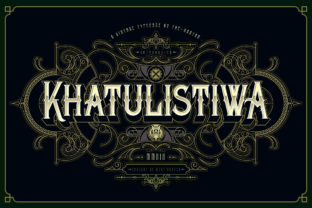
Khatulistiwa is a retro display typeface inspired by the visual language of classic Western films—think weathered posters, hand-painted saloon signs, and sun-bleached typography from mid-20th-century Americana. Designed with intentional irregularities, subtle asymmetries, and textured stroke endings, it evokes analog craftsmanship rather than digital precision. It is not a revival of a specific historical font but a contemporary interpretation built around mood, context, and tactile authenticity.
Who Might Consider Khatulistiwa?
Designers, branding professionals, and creative teams evaluating display fonts for projects requiring strong thematic resonance may find Khatulistiwa worth exploring. Its appeal lies primarily in its ability to communicate tone quickly: ruggedness, nostalgia, adventure, or frontier individualism. It’s especially relevant when the goal is visual distinction within a crowded space—such as festival branding, album artwork, limited-edition packaging, or editorial features with a narrative or cinematic bent.
Key Strengths and Practical Benefits
Khatulistiwa’s most notable strength is its expressive consistency. Unlike many decorative fonts that sacrifice legibility for flair, Khatulistiwa maintains readable letterforms at larger sizes (typically 36pt and up), thanks to generous x-heights and clear character differentiation—even in its more stylized alternates. Its extended Latin character set supports multilingual use across Western European languages, making it viable for international campaigns where stylistic cohesion matters more than linguistic breadth.
The font includes multiple optical variants—Standard, Condensed, and Inline—each serving distinct layout needs. The Condensed version works well in tight horizontal spaces without sacrificing impact; the Inline variant adds dimensionality for layered compositions or print applications where ink trapping or embossing might be used. These options support thoughtful typographic hierarchy without requiring external design tricks.
Tradeoffs and Realistic Expectations
Khatulistiwa is intentionally narrow in scope: it is a display font, not a text face. It is unsuitable for body copy, interface labels, data tables, or any setting demanding high readability at small sizes or extended reading. Attempting to use it below 24pt—especially on screens—risks poor contrast, ambiguous shapes (e.g., i vs. l, or o vs. 0), and inconsistent rhythm.
Its retro aesthetic also carries contextual weight. While effective for projects embracing Western motifs or vintage storytelling, it can feel incongruous or even clichéd when applied to tech, healthcare, finance, or institutional contexts where neutrality, clarity, or modernity are priorities. Users should assess whether the font’s personality aligns with brand values—not just visual preferences.
Additionally, Khatulistiwa does not include OpenType features like automatic ligatures or stylistic sets beyond its core variants. Designers seeking granular control over alternate glyphs or contextual substitutions will need to manage those manually in their layout software.
Situations Where Khatulistiwa Is a Strong Fit
- Film or event branding—particularly for Western-themed festivals, indie documentaries, or theatrical releases leaning into atmospheric storytelling.
- Merchandise and packaging—where physical texture, screen printing, or foil stamping can enhance the font’s hand-crafted impression.
- Editorial covers and title treatments—in magazines or books where typography functions as a visual hook, not functional scaffolding.
- Branded environmental graphics—like murals, signage, or exhibition walls where scale and materiality amplify its tactile qualities.
When Alternatives May Be More Appropriate
If your project requires versatility across multiple weights, widths, or language support—including Cyrillic, Greek, or extended diacritics—Khatulistiwa’s current scope may fall short. Fonts like Brandon Grotesque or FF Meta offer broader utility for systems requiring both display and text functionality.
For projects needing authentic historical accuracy—such as reproducing 19th-century American wood type—dedicated revivals like Wood Type Ornaments or Kepler Sans provide deeper archival fidelity and technical nuance.
If accessibility is a primary concern—for example, in public-facing digital interfaces or educational materials—fonts designed with WCAG-compliant contrast, spacing, and glyph clarity (e.g., Noto Sans or GOV.UK Font) remain more appropriate choices.
Making an Informed Decision
Evaluating Khatulistiwa begins with clarifying intent. Ask: Is the goal to reinforce a theme, evoke a feeling, or solve a functional problem? If the answer leans toward theme or feeling—and the application is appropriately constrained—Khatulistiwa offers a cohesive, memorable option. If the priority is flexibility, scalability, or broad usability, its limitations become more consequential.
Test it early in context. Render Khatulistiwa alongside supporting typefaces (e.g., a neutral sans-serif for body text) to assess contrast, hierarchy, and tonal balance. Print samples at intended sizes and review them under typical viewing conditions—natural light for posters, device screens for web banners. Pay attention to how it behaves across backgrounds: its textured strokes may require careful color pairing to avoid visual noise.
Also consider licensing. Khatulistiwa is typically offered under desktop and web licenses with usage tiers. Projects involving large-scale merchandise distribution or SaaS platforms may require extended rights—review terms before committing to production timelines.
Ultimately, Khatulistiwa serves best when treated as a deliberate choice—not a default. Its value emerges not from ubiquity or adaptability, but from specificity: its ability to anchor a design in a clear, consistent, and evocative place. That makes it less about “what it can do” and more about “what it says”—and whether that message matches what you intend to communicate.