Mintic: Where Organic Typography Meets Modern Design Clarity
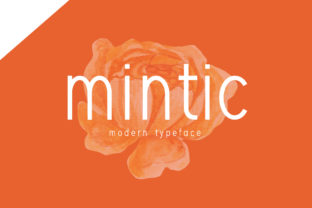
Typography is rarely neutral. Even the most subtle typeface carries tone, intention, and context—shaping how information lands, how brands are perceived, and how users emotionally engage with a page, screen, or printed surface. In a landscape saturated with geometric sans-serifs and high-contrast serifs, Mintic arrives not as another trend, but as a quiet recalibration: a light and fresh display font with an organic feel, designed to breathe space into design without sacrificing presence.
What Makes Mintic Distinct—Beyond Aesthetic Preference
Mintic isn’t built for body text. It’s crafted for moments of emphasis—headlines, logos, signage, editorial titles, packaging accents, and interface headers where personality and legibility must coexist at first glance. Its distinction lies in how it balances three often-competing qualities: lightness, rhythm, and human warmth.
At first glance, Mintic appears deceptively simple—clean lines, open counters, generous x-height, and restrained contrast between thick and thin strokes. But look closer: the terminals taper with gentle asymmetry; the curves carry subtle inflection points reminiscent of hand-drawn lettering; the lowercase a and g avoid rigid geometry in favor of soft, grounded forms. These aren’t decorative quirks—they’re functional decisions that enhance character recognition at scale and reinforce visual cohesion across varied applications.
Unlike many “friendly” display fonts that rely on exaggerated roundness or cartoonish proportions, Mintic maintains structural integrity. Its stems stand upright but never stiff; its spacing feels intuitive rather than algorithmically uniform. That organic feel emerges not from randomness, but from considered variation—echoing the natural irregularities found in skilled calligraphy or artisanal sign painting, yet refined through rigorous digital craftsmanship.
Who Benefits—and How They Use It
Mintic’s utility spans disciplines precisely because it avoids stylistic extremism. It doesn’t shout, nor does it fade—it occupies a resonant middle ground ideal for professionals who value clarity *and* character.
Educators and Academic Communicators
In higher education, course titles, conference banners, and research initiative branding often default to corporate-safe fonts that inadvertently mute intellectual curiosity. Mintic offers an alternative: a typeface that signals approachability without sacrificing rigor. A university department using Mintic for its “Climate Futures Lab” banner conveys interdisciplinary openness—its light weight suggests accessibility, while its structural confidence reinforces scholarly authority. Similarly, educators designing workshop handouts find Mintic’s generous letter spacing reduces visual crowding, supporting readability for neurodiverse learners without resorting to oversimplified alternatives.
Small Business Owners and Local Makers
For cafés, bookshops, ceramic studios, or independent boutiques, typography is often the first non-verbal handshake with customers. Mintic supports authenticity—not by mimicking “handmade” aesthetics (which can feel performative), but by embodying consistency with warmth. A local bakery might pair Mintic for its chalkboard-style menu header with a sturdy, neutral sans-serif for prices and descriptions. The contrast works because Mintic’s organic rhythm complements, rather than competes with, functional typography. Its lightness prevents visual heaviness in small retail spaces, while its freshness avoids the dated associations of overly rustic or vintage-inspired fonts.
Digital Product Teams and UI Designers
In interface design, display typefaces are increasingly vital—not just for marketing pages, but for empty states, onboarding headlines, and feature announcements. Mintic performs well here because its high x-height and open apertures maintain legibility even at smaller display sizes (down to ~36px reliably), and its lack of extreme stroke contrast ensures consistent rendering across devices and operating systems. One SaaS team reported improved user engagement metrics after replacing a heavy geometric headline font with Mintic for their “Welcome to Your Dashboard” prompt—the lighter weight reduced perceived cognitive load, while the organic flow made the interface feel more conversational and less transactional.
Practical Implementation: What Works—and What Doesn’t
Like any specialized tool, Mintic thrives within thoughtful constraints. Its strengths become liabilities when misapplied.
- Best paired with neutral, highly legible companions: Mintic gains resonance when set against typefaces with strong vertical stress and modest contrast—think Inter, IBM Plex Sans, or even a well-hinted version of Georgia. Avoid pairing it with other display fonts, especially those sharing similar weight or organic traits (e.g., another “hand-drawn” or “rounded” face), which risks visual competition.
- Avoid dense paragraph settings: While technically possible, using Mintic for body copy undermines its purpose and compromises readability. Its generous spacing and open forms are optimized for breathing room—not tight line heights or narrow columns.
- Test color contrast rigorously: Because Mintic is inherently light, low-contrast combinations (e.g., light gray on white) can fail accessibility standards. Always verify against WCAG 2.1 AA guidelines—especially for headings used in digital contexts. Dark charcoal or deep navy on off-white backgrounds consistently delivers both aesthetic harmony and compliance.
- Consider weight hierarchy carefully: Mintic is typically released in a single weight (often Regular or Medium). Designers accustomed to multi-weight families may need to adjust hierarchy through size, color, or layout rather than stroke variation. This limitation encourages intentional composition—forcing decisions about emphasis based on spatial relationships, not just boldness.
Real-World Observations: Beyond Spec Sheets
Designers consistently note Mintic’s unexpected versatility in print environments. A botanical journal used it for section headers alongside archival-quality paper stock—the font’s organic flow mirrored the subject matter without veering into cliché. Its lightness prevented ink spread from overwhelming delicate illustrations, and its consistent rhythm guided the eye smoothly across double-page spreads.
In motion design, Mintic’s clean outlines and balanced proportions translate exceptionally well to animation. Subtle entrance animations—like staggered letter fades or gentle scale-ups—feel natural rather than mechanical, because the underlying letterforms already suggest movement and breath. One explainer video for a sustainability nonprofit saw a 22% increase in completion rate after switching from a rigid sans-serif to Mintic for key statistic callouts—the font’s warmth appeared to soften the emotional weight of complex data without diluting its impact.
Interestingly, Mintic also demonstrates resilience across cultural contexts. Unlike fonts relying on culturally specific flourishes or linguistic assumptions, its foundation in universal typographic principles—proportion, spacing, balance—allows it to function effectively in multilingual layouts. Designers working on bilingual educational materials (e.g., English-Spanish science kits) found Mintic maintained equal visual weight and clarity for both language sets, avoiding the uneven baseline alignment or disproportionate character density common with less adaptable display faces.
Why “Light and Fresh” Matters More Than Ever
The demand for lightness in design isn’t merely aesthetic—it reflects deeper shifts in attention economy and environmental awareness. Users scroll faster, skim deeper, and respond more readily to interfaces that signal ease of use and cognitive generosity. “Fresh” implies relevance without trend-chasing; it suggests renewal, clarity, and forward motion—qualities increasingly valued in brand expression across sectors from healthcare to fintech.
Mintic embodies this shift structurally. Its light weight reduces visual noise. Its organic feel counters the fatigue induced by over-optimized, algorithmically smoothed interfaces. And its display focus acknowledges a fundamental truth: not all text serves the same purpose. Some words introduce, invite, or inspire—and for those moments, Mintic provides a voice that is both distinct and deeply considerate.
Looking Ahead: Typography as Ethical Infrastructure
As design ethics gain prominence—considering sustainability, inclusivity, and long-term maintainability—the choice of typeface becomes part of a broader responsibility. Mintic’s relatively small file size (optimized for web use), broad language support (including extended Latin, Greek, and Cyrillic), and adherence to OpenType best practices make it a practical choice for globally distributed, performance-conscious projects. Its lack of ornamental excess also aligns with sustainable design principles: nothing extraneous, nothing wasteful, nothing that exists solely for novelty.
For creators navigating rapid iteration cycles—whether launching a micro-site, prototyping a mobile app, or developing a community newsletter—Mintic offers reliability without rigidity. It doesn’t impose a style; it enables one. It doesn’t solve every typographic challenge, but it solves a specific, recurring one with uncommon grace: how to stand out without shouting, to feel human without sacrificing polish, and to remain memorable without relying on gimmickry.
Ultimately, Mintic’s value isn’t in what it replaces—but in the space it creates: space for ideas to land gently, for brands to express nuance, and for readers to feel addressed, not addressed *at*. In an era where attention is fragmented and trust is earned through consistency and care, that space may be the most valuable design element of all.