Origame: Where Timeless Origami Meets Modern Design Expression
At first glance, Origame might sound like a playful blend of “origami” and “game”—and in many ways, it is. But this isn’t just a whimsical name. Origame is a thoughtfully crafted display font inspired by the elegance, precision, and quiet intelligence of classic origami. Designed to bridge tradition and contemporary visual language, it brings the folded-paper aesthetic into digital typography—offering designers, educators, developers, and creative professionals a fresh, expressive tool that’s both meaningful and highly functional.
What Is Origame—and Why Does It Matter?
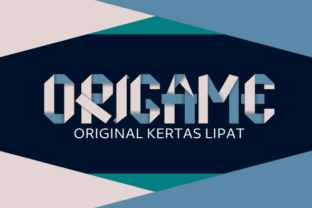
Origame is a display typeface—a category of fonts intended for headlines, logos, posters, and other prominent visual applications where impact and personality matter most. Unlike body text fonts optimized for long-form readability, display fonts like Origame prioritize character, context, and emotional resonance. What sets Origame apart is its deep conceptual roots: every curve, fold, and angular stroke echoes the geometry of hand-folded paper.
Think of the crisp crease where a crane’s wing meets its body—or the subtle taper of a folded lotus petal. Origame translates those physical qualities into typographic form: sharp yet graceful terminals, intentional asymmetry, and rhythmic contrast between thick and thin strokes. It doesn’t mimic paper texture literally; instead, it captures the spirit of origami—order, transformation, and mindful craftsmanship.
The Philosophy Behind the Font
Origami has long symbolized more than just paper-folding. In Japanese culture, it represents patience, intentionality, and the beauty of constraint—turning a single, flat sheet into something three-dimensional through disciplined folds. Origame honors that philosophy by rejecting digital excess. There are no gratuitous flourishes or artificial shadows. Instead, its design reflects intentional minimalism: each letterform feels purpose-built, as if folded rather than drawn.
This makes Origame especially resonant in today’s design landscape—a space increasingly saturated with flashy, algorithmically generated visuals. In contrast, Origame invites pause. It encourages designers to consider *how* a typeface communicates—not just what it says. That depth of meaning is rare in display fonts and is precisely why Origame stands out among modern typographic tools.
Practical Uses Across Industries
While Origame shines in branding and editorial design, its versatility extends far beyond aesthetics. Below are real-world applications where its unique qualities deliver measurable value:
- Educational Materials: Teachers use Origame in classroom posters, STEM activity sheets, and math-infused art projects. Its geometric clarity reinforces spatial reasoning concepts—making abstract ideas like symmetry, angles, and transformations instantly tangible.
- Tech & App Interfaces: UI designers integrate Origame into onboarding screens, feature announcements, and app icons—especially for tools centered on creativity, mindfulness, or learning. Its clean structure ensures legibility at scale, while its organic rhythm softens the digital experience.
- Sustainable Branding: Eco-conscious brands choose Origame to reflect values like simplicity, renewal, and thoughtful resource use. A packaging label set in Origame subtly signals care—not just in product design, but in communication choices.
- Event Identity: From architecture exhibitions to maker fairs and innovation summits, Origame adds sophistication without pretension. Its balance of tradition and modernity makes it ideal for events celebrating human-centered design.
How Origame Fits Into Everyday Creativity
You don’t need to be a professional designer to benefit from Origame. Consider these everyday scenarios:
- A parent creating a birthday invitation: Using Origame for the child’s name adds instant charm and personality—evoking the handmade joy of folding a paper gift box.
- A student designing a science fair poster: Pairing Origame headlines with clean sans-serif body text creates visual hierarchy while reinforcing themes of structure and discovery.
- A small business owner refreshing their social media presence: A single line of Origame text over a neutral background becomes an instantly recognizable visual signature—memorable, warm, and quietly confident.
In each case, Origame does more than “look nice.” It builds connection. It signals care. And because it’s rooted in a universally understood craft—origami—it bypasses cultural barriers, speaking through shape and rhythm rather than language alone.
Dispelling Common Misconceptions
Despite its growing popularity, several assumptions about Origame persist—some of which limit how effectively people use it. Let’s clarify:
- Misconception: “Origame is only for ‘crafty’ or ‘artsy’ projects.”
Reality: While its origins are tactile, Origame performs exceptionally well in high-tech, corporate, and academic contexts—especially when paired intentionally. Its structural integrity gives it authority, not fragility. - Misconception: “It’s hard to read at smaller sizes.”
Reality: This is true—but by design. As a display font, Origame is optimized for headings (24px and up), not paragraphs. Using it for body copy would violate typographic best practices—just as you wouldn’t use a bold serif headline font for a novel. The key is matching function to form. - Misconception: “It’s just another decorative font—no real substance.”
Reality: Origame underwent extensive testing across screen resolutions, color contrasts, and accessibility standards. Its letterforms were refined to support WCAG-compliant contrast ratios, and OpenType features include stylistic alternates for nuanced expression—proof that beauty and utility coexist here.
Why Typography Like Origame Matters Now
In an age of AI-generated content and rapid-fire digital consumption, human intentionality in design has never been more valuable. Fonts are not neutral—they’re cultural artifacts. Every time we choose a typeface, we signal priorities: speed or care, uniformity or individuality, noise or clarity.
Origame responds to a quiet but growing demand: for tools that feel authentic, not algorithmic; grounded, not generic; and meaningful, not merely trendy. It reminds us that even in digital spaces, craft endures—and that inspiration can come from folding a square of paper in silence.
Moreover, Origame supports inclusive design thinking. Its clear shapes aid readers with dyslexia when used appropriately (e.g., in large-format signage or presentation slides). Its restrained palette of weights avoids visual fatigue—a subtle but important consideration for neurodiverse audiences.
Getting Started With Origame
Integrating Origame into your next project is straightforward:
- Download the font files directly from the official Origame website, which offers free trial versions and commercial licenses.
- Use it in design tools like Figma, Adobe Creative Cloud, or Canva via webfont integration or local installation.
- Pair it thoughtfully: try combining Origame headlines with neutral sans-serifs like Inter or Lato for body text—creating harmony between expressive energy and functional clarity.
- Explore its OpenType features—such as alternate “folded” glyphs for letters like A, M, and V—to add subtle thematic depth to custom wordmarks or monograms.
Remember: great typography isn’t about standing out at all costs. It’s about serving the message—and honoring the people who receive it. Origame does both, elegantly.
Final Thought: More Than a Font—A Mindset
Origame is more than a collection of vector paths. It’s an invitation—to slow down, to fold with purpose, to design with empathy. Whether you’re launching a startup, teaching fractions to fifth graders, or simply sending a heartfelt email header, Origame offers a quiet reminder: how we present ideas matters as much as the ideas themselves.
So the next time you reach for a display font, ask yourself: Does it reflect the values behind your work? Does it honor the viewer’s attention? Does it carry meaning—not just style?
If the answer is yes, you’ve likely found your fold.