The Creepy House
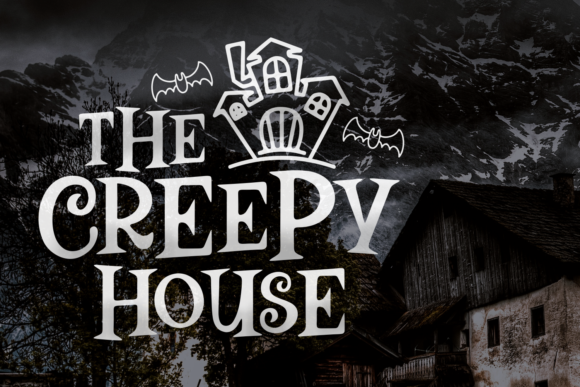
Typography plays a quiet but decisive role in setting tone—especially for seasonal or thematic projects. The Creepy House is a display font designed with intention: to evoke the off-kilter charm of vintage Halloween ephemera without slipping into cliché. It’s not a generic “spooky” typeface with dripping blood or exaggerated serifs. Instead, it leans into asymmetry, uneven baseline alignment, subtle distortions, and hand-drawn irregularity—all while maintaining legibility at medium to large sizes. That balance makes it unusually versatile for professionals who need expressive impact without sacrificing clarity.
What Makes This Font Stand Out in Practice
At first glance, The Creepy House feels like something pulled from a 1950s haunted house attraction poster—slightly warped, faintly nostalgic, and unmistakably intentional. Its letterforms feature gentle slants, inconsistent stroke weights, and playful inconsistencies: the lowercase g has a looping tail that curls just a little too far; the uppercase R tilts forward as if leaning into a whisper; the Q includes a tiny, off-center dot that reads more like a wink than a flaw. These aren’t bugs—they’re calibrated quirks, carefully spaced and kerned to avoid visual fatigue.
Unlike many novelty fonts that sacrifice spacing or hinting for effect, The Creepy House ships with full OpenType support, including standard ligatures and stylistic alternates. That means designers can toggle between versions of certain characters (like a more exaggerated W or a simplified 8) without switching families. The font renders cleanly across platforms—tested on macOS Ventura, Windows 11, and recent Chrome, Firefox, and Safari builds—with no rendering artifacts or fallback issues in print-ready PDFs or web embeds using @font-face.
Where It Delivers Real Value
The Creepy House excels where atmosphere matters more than neutrality: event posters, limited-edition product packaging, social media banners for seasonal campaigns, and themed email headers. A small business owner launching a Halloween pop-up shop used it for window decals and menu boards—and reported higher dwell time and photo shares from customers compared to their previous sans-serif approach. Similarly, an independent educator building a middle-school literacy unit on gothic fiction applied The Creepy House to chapter title slides. Students consistently identified those slides as “more exciting to read,” without confusion over word recognition.
Its effectiveness hinges on restraint. Used at 36pt or larger for headlines and short phrases, it commands attention without overwhelming. At smaller sizes—even 24pt—it begins to lose cohesion, especially in body copy or dense UI elements. That’s not a shortcoming; it’s a design boundary. The Creepy House was never built for paragraphs, navigation menus, or data tables. Recognizing that limitation upfront helps users deploy it purposefully rather than forcing it where it doesn’t belong.
Usability and Workflow Integration
Installation is straightforward: drag-and-drop into Font Book (macOS) or Fonts folder (Windows), or import via Figma, Adobe Creative Cloud, or Sketch. No plugins or licensing gateways are required for standard use. The family includes one weight—Regular—with no italic or bold variants. That may sound limiting, but it reinforces the font’s identity: it’s a singular voice, not a system. Designers who need contrast pair it cleanly with neutral sans-serifs like Inter, Poppins, or even Helvetica Neue—letting The Creepy House carry the personality while supporting text stays grounded.
Kerning pairs are well-considered, though manual adjustments may be needed for specific combinations (e.g., “VY” or “To” can feel slightly tight in all-caps settings). Most users won’t notice this in headlines under ten words—but for longer festival names or taglines, a quick pass in Glyphs or Illustrator pays off. There’s no variable axis, so responsive scaling requires discrete size breakpoints rather than fluid interpolation. Again, this reflects its focus: controlled, intentional application—not adaptive utility.
Audience Fit: Who Benefits Most—and When
Freelancers building brand assets for bakeries, craft breweries, or indie bookstores often juggle tight timelines and broad aesthetic expectations. The Creepy House gives them a fast, licensable option that reads as custom without requiring illustration work. Marketers running October campaigns appreciate its immediate thematic resonance—no art direction needed to explain “why this feels spooky.” Bloggers covering horror cinema or folklore find it effective for featured post titles and newsletter banners, where tone signals audience alignment before the first sentence is read.
It’s less suited for corporate communications, accessibility-first interfaces, or multilingual projects. The character set covers Latin-1 (including accented characters for French, Spanish, and German), but lacks extended diacritics, Cyrillic, or Greek support. Users targeting global audiences or needing WCAG-compliant contrast ratios should test contrast manually—its thin strokes and light weight mean it performs best against dark, non-black backgrounds (e.g., charcoal, deep navy) rather than pure black or white.
Long-Term Considerations and Practical Limits
Font longevity depends less on trendiness and more on adaptability within constraints. The Creepy House avoids dated tropes (no cobwebs, no cartoonish fangs), opting instead for subtlety that ages well. A 2022 campaign using it still feels fresh in 2024—not because it’s timeless, but because its quirks serve function, not just fashion. That said, overuse dilutes impact. Rotating it across two or three seasonal projects per year maintains its distinctiveness; applying it to every Halloween asset for five years risks visual fatigue among repeat viewers.
Licensing is clear and commercially friendly: one-time purchase with perpetual use across unlimited projects, including client work. No subscription, no usage caps, no attribution required. That simplicity matters to small studios and solopreneurs managing multiple tools and subscriptions. Still, users should verify license terms directly from the foundry—some third-party resellers list outdated versions or omit desktop/web distinctions.
Final Recommendation
If your goal is to signal mood quickly and authentically—to make a flyer feel like a midnight invitation, a label feel like a secret recipe, or a headline feel like a creaking floorboard—The Creepy House delivers with precision. It’s not a replacement for typographic systems, nor does it aim to be. It’s a focused tool: expressive, well-engineered, and honest about its scope. Use it where voice matters more than versatility, where delight is part of the message, and where you’re willing to let typography do quiet, confident work. For creators who value intention over ornamentation, it earns its place—not as background noise, but as a considered accent.