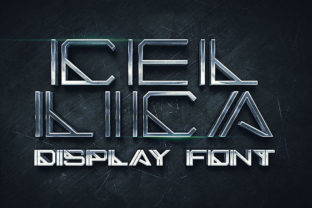
Cellica - Display
Cellica - Display is a contemporary sans-serif typeface designed specifically for prominent visual impact at larger sizes. Unlike text fonts optimized for extended reading, Cellica - Display prioritizes distinct letterforms, balanced proportions, and subtle geometric precision to deliver clarity and presence in headings, logos, posters, and digital banners. It is not intended for body copy or small-scale interface elements—its design choices reflect that intentional focus.
Why Designers Consider Cellica - Display
Designers often seek display fonts when they need to establish tone quickly, reinforce brand identity, or guide visual hierarchy without relying solely on layout or color. Cellica - Display enters this category as a font that balances modernity with legibility. Its clean terminals, open counters, and consistent stroke contrast support readability even in dynamic contexts—such as responsive web headers or motion graphics—where some highly stylized display fonts may falter.
Interest in Cellica - Display typically arises during phases of visual system development: refining a brand’s typographic palette, refreshing marketing assets, or selecting a headline font that complements—but doesn’t compete with—an existing text face. Its restrained personality makes it suitable for projects where “modern” shouldn’t mean “futuristic” or “experimental,” but rather confident, approachable, and time-aware.
Key Benefits and Practical Strengths
Cellica - Display offers several functional advantages:
- Strong visual hierarchy: Its generous x-height and deliberate spacing ensure immediate recognition at scale, helping users parse information faster in editorial or promotional layouts.
- Neutral versatility: It avoids extreme stylistic flourishes, allowing it to pair effectively with a range of serif and sans-serif text fonts—including both humanist and geometric options—without clashing tonally.
- Consistent rendering: Tested across major platforms and browsers, Cellica - Display maintains its intended proportions and spacing in standard webfont formats (WOFF2, variable font instances where available), reducing unexpected shifts in layout during implementation.
- Optimized for screen and print: While designed digitally, its outlines translate well to high-resolution print applications like exhibition signage or packaging, provided sizing guidelines are followed.
Tradeoffs and Realistic Expectations
No display font excels universally—and Cellica - Display is no exception. Its strengths emerge most clearly when used intentionally. For example:
- It lacks extensive language support beyond Latin-based scripts, limiting suitability for multilingual interfaces or global campaigns requiring Cyrillic, Greek, or extended diacritic coverage.
- It does not include optical size variants (e.g., caption, subhead, display). Designers must manually adjust tracking, weight, or scale depending on context—especially below ~36px, where tighter spacing may be needed for clarity.
- Its relatively uniform stroke contrast means it may appear less distinctive than high-contrast or monoline alternatives in highly competitive visual environments (e.g., social media thumbnails with dense imagery).
- Licensing terms vary by vendor and use case (web, desktop, app embedding). Users should verify permitted usage scope before committing to large-scale deployment.
When Cellica - Display Is a Strong Fit
Cellica - Display works well in scenarios where clarity, cohesion, and quiet confidence matter more than novelty. Consider it for:
- Brand systems seeking consistency: When paired with a neutral, highly legible text font (e.g., Inter, Lato, or a well-hinted serif like Merriweather), Cellica - Display can anchor a typographic hierarchy that feels intentional and scalable.
- Digital product dashboards or admin interfaces: As a header font, it adds visual distinction without overwhelming data-dense screens—particularly where users scan rather than read linearly.
- Editorial websites and newsletters: Its rhythm supports scannable headlines and section breaks, especially in long-form content where tone remains professional yet accessible.
- Event branding and environmental graphics: In physical spaces like conference signage or exhibition walls, its balanced forms hold up under varied lighting and viewing distances.
When Alternatives May Be More Appropriate
Cellica - Display is less suited for projects requiring:
- High stylistic contrast: If your design relies on juxtaposing starkly different moods (e.g., playful + authoritative), a more expressive display font—or a carefully curated pairing of two distinct display faces—may serve better.
- Extensive multilingual support: Projects targeting audiences using non-Latin scripts will likely need complementary fonts or a broader family with extended character sets.
- Dynamic typographic scaling: For fluid, responsive typography that adapts seamlessly from mobile to billboard, variable fonts with axis control (e.g., weight, width, optical size) offer more granular adjustment than static Cellica - Display weights alone.
- Highly constrained technical environments: Legacy systems or embedded devices with limited font loading capabilities may benefit from lighter, more widely supported system fonts instead of custom display options.
Making an Informed Decision
Evaluating Cellica - Display begins with clarifying your project’s typographic requirements—not just aesthetic preferences. Ask yourself:
- What role will the font play? (e.g., primary headline only, full suite of UI labels, logo lockup)
- At what sizes and in which mediums will it appear most frequently?
- Which languages and character sets must it support reliably?
- How does it interact with your chosen text font in real layouts—not just side-by-side specimens?
- Does your delivery environment (web, app, print) align with the font’s technical specifications and licensing terms?
Testing Cellica - Display in actual mockups—not just font previews—is essential. Try it alongside your content: apply it to real headlines, measure line lengths, assess contrast against backgrounds, and review rendering on target devices. Compare it against two or three alternatives using identical conditions. This comparative process reveals how it performs—not just how it looks.
Ultimately, Cellica - Display serves best as a deliberate choice within a thoughtful typographic strategy—not as a default or decorative flourish. Its value lies in reliability, restraint, and quiet effectiveness: qualities that become more apparent the longer it’s used, not the moment it’s selected.