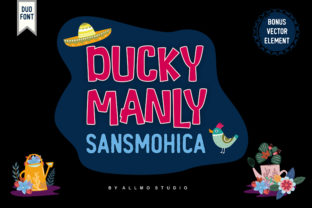
Ducky Manly: Playful Typography with Purpose
When your brand voice leans into warmth, wit, or wonder—Ducky Manly isn’t just another font. It’s a design collaborator. Designed with intentional irregularity and expressive flexibility, Ducky Manly invites you to break rigid typographic rules without sacrificing clarity. Its playful energy comes from subtle variations in stroke weight, uneven baselines, and character-specific quirks—not randomness, but considered charm. That makes it especially useful when authenticity matters more than uniformity.
Why Letterplay Matters More Than You Think
Most fonts treat uppercase and lowercase as fixed sets. Ducky Manly treats them as interchangeable tools. Swap a bold, bouncy capital “D” next to a relaxed, slightly slanted lowercase “u” and “c”, and suddenly your headline breathes differently. This isn’t decorative chaos—it’s visual rhythm you control. Designers use this to guide attention: lead with a strong cap for impact, then soften the rest with lowercase flow. Bloggers apply it to subheads that feel conversational yet intentional. Educators use it in classroom posters where friendliness supports comprehension—not distracts from it.
Try pairing “Ducky” in full caps (with its generous x-height and rounded terminals) against “Manly” in lowercase with slight leftward lean. The contrast feels human—not algorithmic. That small shift signals approachability while retaining authority. It’s why small business owners choosing Ducky Manly for shop signage often report customers describing their space as “inviting but trustworthy.”
Mixing Memphis-Style Doodles Without Overloading
The included Memphis-style doodles—think geometric stars, zigzag borders, wavy lines, and abstract brackets—are not clipart. They’re drawn with the same hand-drawn confidence as the letters. That consistency is key. When layered thoughtfully, they reinforce tone instead of competing with text. A freelance illustrator might place a single angular star beside a project title in Ducky Manly to imply creativity and precision. A newsletter creator could use a looping squiggle as a bullet point—replacing sterile circles with something memorable but legible at 14px.
Crucially, these elements scale cleanly. Unlike raster-based icons, the doodles are vector-based and align optically with letter spacing. That means no awkward gaps or misaligned anchors when resizing across devices. Test it: set a paragraph in Ducky Manly at 18px on desktop and 16px on mobile—the doodles retain proportion and intent. That saves time in responsive refinement, especially for marketers building email templates or social assets across platforms.
Where Ducky Manly Fits—and Where It Doesn’t
Ducky Manly shines in contexts where personality carries weight: event invitations, product packaging for lifestyle brands, workshop handouts, podcast cover art, or landing pages for creative services. It’s less suited for long-form body copy, legal disclaimers, or data-heavy dashboards—its expressive nature can slow scanning speed in dense text. That’s not a flaw; it’s alignment with purpose. Knowing when *not* to use it is part of using it well.
For example, a yoga studio owner might use Ducky Manly for class names (“Moon Flow • Sunset Stretch”) but switch to a neutral sans-serif for schedule grids. A children’s book illustrator could layer Ducky Manly headlines over hand-painted backgrounds—its organic imperfections echo traditional illustration techniques. Meanwhile, a fintech startup would likely reserve it for campaign visuals only, not dashboard UI.
Real Creativity Starts With Constraints
“Endless possibilities” sounds liberating—until you face a blank canvas. Ducky Manly works because its constraints are clear: playful, human-scaled, Memphis-influenced, and deliberately imperfect. Those boundaries focus decisions. Instead of asking “What font fits everything?”, you ask “What feeling does this message need *right now*?” Then you reach for the right cap, the right lowercase, the right doodle—or none at all.
That’s why educators building digital lesson kits find Ducky Manly helpful: students notice headings faster, recall concepts better when visual cues match tone (e.g., a “Science Safari” title with leaf doodles), and engage more deeply when typography feels like part of the story—not just decoration. It’s not about making things “cute.” It’s about making meaning visible.
Practical Tips for Getting Started
- Start simple: Use only one case variation per line—no more than two doodles per composition unless you’re designing a poster or banner.
- Pair intentionally: Ducky Manly pairs best with clean, low-contrast sans-serifs (like Inter or Lato) for supporting text—not other display fonts. Contrast creates hierarchy; similarity creates noise.
- Test readability early: At 24px+, Ducky Manly reads effortlessly. Below 16px, some lowercase forms (like “a” or “g”) lose distinction. Reserve small sizes for short labels or icons—not paragraphs.
- Leverage OpenType features: If your design tool supports it, enable stylistic alternates—some lowercase letters have optional versions with tighter curves or sharper angles. These aren’t gimmicks; they let you fine-tune tone within the same font family.
Who Benefits Most—and Why
Creative professionals who juggle multiple client voices—freelance designers, branding consultants, content strategists—find Ducky Manly valuable because it adapts without losing identity. A single font file delivers range: whimsy for a bakery rebrand, grounded playfulness for an edtech platform, gentle irreverence for a podcast about philosophy. That reduces font licensing overhead and speeds up mockup iteration.
Hobbyists and small business owners benefit too—but not because it’s “easy.” Because it’s forgiving. If your Canva design lacks polish, Ducky Manly’s built-in character gives it instant cohesion. If your DIY wedding invite feels flat, swapping standard caps for Ducky Manly’s expressive “W” and adding a single zigzag divider adds intentionality—not extra work.
Still, it’s not universal. If your work prioritizes neutrality (e.g., corporate reports, academic journals, government interfaces), Ducky Manly’s personality may dilute messaging. In those cases, its value lies elsewhere: as a tool for brainstorming, moodboarding, or internal team communications—where human connection matters most.
A Final Thought on Intentional Play
Typography isn’t neutral. Every font carries assumptions about tone, audience, and priority. Ducky Manly assumes your audience values authenticity over perfection—and that clarity doesn’t require rigidity. It rewards attention to detail: noticing how a lowercase “y” descends just enough to anchor a line, or how a doodle’s angle echoes the slant of adjacent letters. That attention pays off—not in likes or shares, but in recognition, retention, and resonance.
So before reaching for the default, ask: Does this need to feel made—or found? Handled—or held? Ducky Manly answers the latter. Not with flash, but with thoughtful, joyful craft.