Quman: Where Playful Typography Meets Purposeful Design
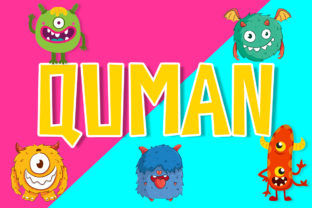
Typography is rarely just about legibility—it’s about voice, tone, and intention. In a digital landscape saturated with minimalist sans-serifs and overused slab fonts, Quman arrives not as background noise, but as a deliberate, joyful interruption. It’s a striking display font with a distinctive cartoon style—rounded, expressive, and unapologetically human. Yet beneath its whimsical surface lies serious design intelligence: optical balance, consistent rhythm, and thoughtful spacing that supports both attention-grabbing impact and contextual harmony. This isn’t novelty for novelty’s sake; it’s typographic personality engineered for resonance.
What Makes Quman Visually Distinctive?
At first glance, Quman feels familiar—like the hand-drawn lettering on a neighborhood bakery sign or the bold title sequence of a beloved animated series. But closer inspection reveals deliberate craftsmanship. Its characters feature gently exaggerated proportions: oversized counters in ‘a’, ‘e’, and ‘o’; soft, springy terminals that taper like ink blots drying mid-stroke; and subtle asymmetries that mimic organic gesture rather than mechanical precision. The uppercase ‘M’ and ‘W’ have playful, slightly uneven legs; the lowercase ‘g’ uses a single-story form with a buoyant loop; and the ampersand (&) transforms into a smiling, interlocked figure.
Unlike many cartoon-inspired typefaces that sacrifice readability at small sizes or in dense text blocks, Quman maintains clarity even when scaled down to 24px in UI headings or used in tight editorial layouts—provided it’s deployed intentionally. Its x-height is generous, ascenders and descenders are moderate (not extreme), and letter spacing is calibrated to prevent visual crowding. These aren’t accidental traits—they reflect deep understanding of how the eye processes shape, contrast, and rhythm across devices and distances.
Who Benefits Most from Using Quman?
Quman doesn’t serve every use case—but where it lands, it lands meaningfully. Its strongest value emerges among creators and organizations whose mission hinges on approachability, imagination, or emotional connection.
- Educators and EdTech designers use Quman in early-learning apps and classroom posters because its friendly forms reduce cognitive load for emerging readers. A phonics worksheet titled “Sam’s Silly Snake Sings” set in Quman feels inviting—not intimidating—especially for children still decoding letter shapes.
- Independent brands and local businesses, particularly those rooted in craft, food, or community, adopt Quman to signal warmth and authenticity. Think: a ceramic studio’s website banner, a seasonal farmers’ market logo, or packaging for small-batch kombucha. Here, Quman replaces sterile corporate fonts without veering into childish cliché.
- UX writers and product teams apply Quman selectively—for empty-state illustrations (“Nothing here yet! Add your first project”), onboarding modals, or celebratory microcopy (“You leveled up! 🌟”). Its expressiveness adds tonal nuance that static system fonts can’t replicate.
- Illustrators and motion designers integrate Quman as a compositional element—not just text, but texture. Its contours align naturally with hand-drawn assets, and its bounce translates well into subtle hover animations or staggered reveal sequences in web banners.
Practical Applications Beyond the Obvious
While Quman shines in headlines and logos, its utility extends further when paired thoughtfully with supporting typefaces. Consider these real-world integrations:
Editorial Storytelling in Digital Magazines
A climate-focused publication ran a feature on urban rewilding titled “The Rooftop Bees of Berlin.” Instead of defaulting to a high-contrast serif for the headline, they chose Quman at 48px—set tight, with generous line height—and paired it with a warm, highly readable humanist sans (like Inter or IBM Plex Sans) for body copy. The contrast didn’t distract; it framed the story as both scientifically grounded and emotionally urgent. Readers reported higher dwell time on that page—suggesting Quman’s charm acted as a gentle gateway into complex subject matter.
Accessibility-Conscious Branding
A nonprofit supporting neurodiverse youth selected Quman for their campaign materials—not despite accessibility concerns, but because of them. With guidance from inclusive design consultants, they tested Quman alongside alternatives using screen readers, color contrast analyzers, and user interviews. Results showed that while Quman isn’t suitable for long-form body text, its distinct letterforms reduced misreading of similar glyphs (e.g., ‘I’, ‘l’, and ‘1’) in short labels and callouts. When combined with sufficient contrast (at least 4.5:1 against background) and responsive sizing, it became part of a broader accessibility strategy—not an exception to it.
Physical-Digital Continuity
A museum gift shop redesigned its in-store signage and e-commerce site simultaneously. They used Quman for shelf talkers (“Handblown Glass • Made in Portland”) and mirrored that exact weight and tracking in their online product cards. That consistency strengthened brand recognition across touchpoints—shoppers who saw Quman on a tag remembered it when browsing later on mobile. No translation loss. Just cohesive presence.
Key Considerations Before Implementation
Adopting Quman requires more than aesthetic alignment—it demands strategic intent. Here’s what experienced designers observe:
- Licensing scope matters. Quman is available in multiple weights (Light, Regular, Bold) and includes Latin, extended Latin, and basic Cyrillic support—but not full multilingual coverage. Teams launching globally should verify glyph completeness for target languages before committing to large-scale usage.
- Performance is manageable—but not automatic. At ~60 KB for the WOFF2 Regular file, Quman loads efficiently when served via modern CDNs and properly subsetted (e.g., removing unused accented characters for English-only sites). However, loading all seven weights unnecessarily will slow render times. Prioritize critical weights only.
- Context overrides charm. Quman struggles in low-resolution environments (e.g., legacy printers, some smartwatch interfaces) and clashes severely with ultra-thin, geometric typefaces. It thrives beside warm, moderately weighted companions—not stark monospaced or ultra-condensed fonts.
- Tone calibration is essential. Used inappropriately—say, on a legal disclaimer or hospital intake form—Quman can unintentionally undermine seriousness or trust. Its strength lies in signaling openness, creativity, or care—not authority or austerity.
How Quman Fits Into Broader Typographic Trends
Quman reflects a larger shift away from homogenized digital typography toward intentional eclecticism. We’re seeing fewer “default” fonts dominating SaaS dashboards and more bespoke pairings that reinforce brand ethos. This isn’t about rejecting neutrality—it’s about recognizing that neutrality itself carries connotations (efficiency, scale, uniformity), and sometimes the most professional choice is to embrace gentle imperfection.
It also aligns with rising demand for emotionally intelligent design: interfaces and communications that acknowledge users’ psychological states. A fintech app might use Quman sparingly in its financial wellness section (“Your savings journey starts here”) to soften the anxiety often tied to money topics—while keeping transactional screens in a clear, neutral sans-serif. That duality—clarity where needed, warmth where welcome—is where Quman earns its place.
Getting Started: A Thoughtful Integration Path
Teams exploring Quman shouldn’t begin with “Where can we use it?” but with “What feeling do we want this moment to evoke—and is Quman the most precise tool for that?” Start small:
- Identify one high-impact, low-risk touchpoint: a newsletter header, a section divider in a report, or a CTA button on a landing page.
- Test with real content—not lorem ipsum. Does “Join the Adventure” feel energizing? Does “Meet Our Team” feel welcoming? If phrasing feels strained, the issue may be voice—not font.
- Validate pairing dynamics. Try Quman above three different body fonts at identical sizes and weights. Which combination creates the clearest hierarchy without visual competition?
- Measure perception, not just preference. Ask testers open-ended questions: “What would you expect this organization to value?” or “How does this headline make you feel about the content below?” Their answers reveal whether Quman is reinforcing—or obscuring—your intended message.
Ultimately, Quman succeeds not because it’s “fun,” but because it’s functionally expressive. It communicates through shape, proportion, and rhythm—just as carefully as any serif or sans-serif. Its cartoon style isn’t decorative fluff; it’s a language—one that speaks fluently to empathy, curiosity, and humanity. When matched with purpose, restraint, and respect for context, Quman becomes more than a font. It becomes a quiet collaborator in meaningful communication.