Dandilon: A Playful Display Font with Authentic Character
Dandilon stands out as a display font designed for impact—not subtlety. It’s not intended for body text, long paragraphs, or interface labels. Instead, Dandilon delivers expressive personality in headlines, logos, posters, social media graphics, and short-form visual branding. Its value lies in its ability to communicate energy and approachability without relying on clichéd “fun” tropes like exaggerated bounce or cartoonish outlines. That authenticity is what makes Dandilon worth considering when tone matters as much as legibility.
What Defines Dandilon’s Visual Personality
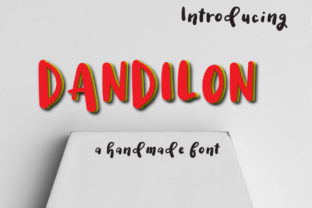
At first glance, Dandilon balances irregularity with intention. Its letterforms feature subtle variations in stroke weight, gentle asymmetry in curves, and soft, slightly uneven terminals—details that evoke hand-drawn charm without sacrificing typographic discipline. The uppercase letters carry more presence than the lowercase, which are proportionally smaller and less dominant—a trait common in display fonts optimized for title use. The “a”, “g”, and “e” include open counters and relaxed apertures, contributing to airflow and readability at larger sizes.
Unlike many playful fonts that lean heavily into retro or grunge aesthetics, Dandilon avoids dated stylistic shortcuts. It doesn’t mimic chalk, brush, or distressed ink—it suggests them lightly, through rhythm and gesture. This gives it staying power across contexts where trend-driven typefaces might feel dated within a year. Its spacing is carefully tuned: generous tracking works well for single-line headlines, while tighter settings remain legible in constrained layouts like mobile banners or app splash screens.
Where Dandilon Performs Best—And Where It Doesn’t
Dandilon excels in environments where brevity meets intention. Think event posters (“Summer Jam 2024”), podcast cover art, newsletter headers, product launch announcements, or branded merchandise like tote bags and enamel pins. In each case, the font supports a message that benefits from warmth and immediacy—not neutrality or authority.
A freelance educator used Dandilon for workshop thumbnails on Instagram. The font’s friendly irregularity helped differentiate her content from competitors using overused sans-serifs like Montserrat or Poppins, while still maintaining clarity at thumbnail scale. Similarly, a small-batch ceramics brand applied Dandilon to packaging stickers—its tactile rhythm echoed the handmade quality of their products without requiring illustration.
It does not work well for extended reading, UI navigation, data tables, or any setting demanding high functional legibility. Its lowercase “l”, “i”, and “1” can blur together at smaller sizes, and its lack of true italics or extensive OpenType features (like stylistic alternates or fractions) limits typographic flexibility in complex editorial layouts. If your project requires multilingual support beyond basic Latin-1, verify character coverage—Dandilon includes accented characters for Western European languages but stops short of Central/Eastern European or Cyrillic sets.
Usability and Integration in Real Workflows
Installing and using Dandilon is straightforward. It’s available in standard OTF and TTF formats, compatible with Adobe Creative Cloud apps, Figma, Sketch, and most modern design tools. No webfont hosting platform is required for basic use—but if you plan to deploy it on a live website, ensure licensing permits web embedding. Some versions include variable font axes (like weight or width), though the core release is static. That means designers should plan contrast thoughtfully: pairing Dandilon with a clean, neutral sans-serif (e.g., Inter, Lato, or even system fonts like -apple-system) creates effective hierarchy without visual competition.
One practical note: Dandilon’s x-height is modest, so line-height adjustments may be needed when layering it over imagery or gradients. Test at actual output size—especially for print. On uncoated paper, fine details in letters like “S” or “B” may soften slightly; a slight bold variant (if available) or minimal outline can reinforce definition without compromising character.
Who Benefits Most From Dandilon—and Why
Entrepreneurs launching lifestyle brands, educators building course identities, bloggers curating visual newsletters, and small business owners refreshing seasonal promotions often find Dandilon especially useful. These users typically need to convey distinct voice quickly, operate with limited design resources, and prioritize emotional resonance over technical complexity. Dandilon lowers the barrier to achieving personality in typography without requiring custom lettering or illustration skills.
It’s less suited for corporate rebrands aiming for timelessness, legal or financial services needing gravitas, or publishers managing large-scale, multi-author digital publications. Those contexts benefit more from versatile text families with robust weights, optical sizing, and language support—qualities outside Dandilon’s scope by design.
Practical Pairings and Production Tips
- For digital use: Set Dandilon at 48px minimum for headlines on desktop; 36px is often the lower threshold for mobile. Avoid all-caps unless intentionally emphasizing rhythm over readability.
- For print: Use 100% black or rich black (C:60 M:40 Y:40 K:100) on white or light backgrounds. Avoid low-contrast combinations like grey-on-grey.
- Pair wisely: Combine with a highly legible, humanist sans-serif for supporting text. Avoid other display fonts or overly geometric sans-serifs that clash with Dandilon’s organic flow.
- Licensing check: Confirm whether your intended use—especially web, app, or merchandise—falls within the license terms. Some free versions restrict commercial redistribution.
Long-Term Value and Design Judgment
Dandilon’s longevity depends less on technical specs and more on how deliberately it’s applied. Fonts like this age well when used with restraint and purpose—not as decorative filler. Overuse dilutes impact; one strong application per campaign or identity system sustains freshness. Its consistency across weights (where available) and platforms ensures predictable output, and its file size remains lightweight—no performance trade-offs in web delivery.
That said, Dandilon isn’t a universal solution. It’s a specialist tool: effective when matched to projects where voice, mood, and memorability outweigh strict neutrality or scalability. Experienced designers appreciate its balance of craft and accessibility—neither overly rigid nor arbitrarily loose. For those evaluating type as part of broader brand strategy, Dandilon offers a reliable option for injecting warmth without veering into informality that undermines credibility.
If your next project calls for a headline that feels human before it feels polished—if you’re choosing between generic polish and genuine expression—Dandilon merits a close look. Not as a default, but as a considered choice rooted in what the message needs, not just what looks new.