Funnyworld: A Playful 3D Font Built for Impact, Not Just Gags
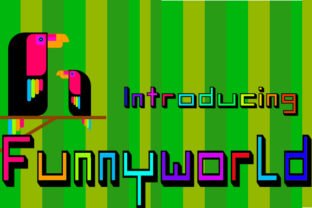
Funnyworld isn’t another novelty typeface designed solely for birthday invitations or meme captions. It’s a carefully constructed 3D display font that delivers expressive, dimensional letterforms with intentional rhythm and structural integrity. What sets it apart is its balance: it leans into humor without sacrificing legibility at scale, and embraces visual dynamism while maintaining typographic coherence. For professionals who need to signal levity—without undermining credibility—Funnyworld offers a rare middle ground.
What Makes Funnyworld Distinctive (Beyond the Obvious)
At first glance, Funnyworld’s exaggerated extrusions, subtle bevels, and playful distortions suggest pure whimsy. But closer inspection reveals thoughtful design decisions. Each glyph features consistent depth mapping across weights, meaning “A” and “Z” share proportional volume and light-shadow logic—not just arbitrary puffiness. The curves are smooth and vector-precise, avoiding pixelation or rendering inconsistencies in print or high-DPI digital outputs. Unlike many 3D fonts that rely on layered effects or raster overlays, Funnyworld is built as a native OpenType font, supporting standard typographic controls like kerning pairs, ligatures (where appropriate), and variable-width spacing.
The “dynamic twist” referenced in its description manifests not in chaotic movement, but in intelligent optical compensation: taller ascenders subtly taper, rounded letters retain even stroke contrast, and lowercase “g” and “y” include clean, weighted descenders that anchor the line. This attention prevents the design from feeling cartoonish in contexts where tone matters—like an edtech startup’s explainer video title, a boutique coffee roaster’s limited-edition bag, or a nonprofit’s awareness campaign targeting younger adults.
Practical Strengths Across Real Workflows
Funnyworld excels where visual tone must shift quickly and deliberately. In motion graphics, its inherent depth translates well to subtle parallax or rotation—no complex modeling needed. Designers using After Effects or Figma report faster iteration because the base geometry responds predictably to lighting and perspective adjustments. In static applications, it holds up cleanly at sizes above 48pt in headlines, posters, and signage, especially when paired with a neutral sans-serif body font like Inter or IBM Plex Sans.
Its OpenType features include stylistic alternates for select characters (e.g., a winking “O”, a tilted “Q”), which add controlled personality without requiring manual editing. These aren’t gimmicks—they’re functional tools. A marketing team launching a lighthearted product variant can use the alternate “R” in the logo lockup, then revert to the standard set for subheadlines, maintaining brand continuity while varying expression.
Quality control is evident in cross-platform testing. Funnyworld renders consistently in Chrome, Safari, and Edge; embeds reliably in PDFs for client presentations; and converts cleanly to outlines in Adobe Illustrator for print production. No reported issues with missing glyphs or fallback behavior in CMS environments like WordPress or Webflow—important for bloggers or small business owners managing their own sites.
Who Benefits—and When It Fits (and Doesn’t)
Funnyworld serves creators whose audiences respond well to approachability, warmth, and gentle irreverence—not forced silliness. Educators developing STEM outreach materials for middle-schoolers find it effective for slide titles (“Why Do Volcanoes *Pop*?”). Freelance designers building brand identities for indie game studios or creative agencies use it for logotypes where differentiation matters but professionalism can’t be compromised. Small business owners in food, wellness, or lifestyle niches apply it selectively—for example, on seasonal menu boards or Instagram story highlights—where it adds memorability without alienating repeat customers.
It’s less suitable for long-form text, data-heavy dashboards, legal disclaimers, or accessibility-critical interfaces. Its 3D structure reduces contrast in smaller sizes, and the depth effect can interfere with screen readers’ glyph interpretation (though this is mitigated by proper semantic HTML and alt-text usage in implementation). Also, brands operating in highly regulated sectors—finance, healthcare compliance, enterprise B2B—may find its tone misaligned unless used extremely sparingly and contextually (e.g., only in internal culture campaigns).
Flexibility and Integration Realities
Funnyworld comes in two primary weights—Regular and Bold—with matching italics. While not a full variable font, the pairing provides enough contrast for hierarchy in most editorial or promotional layouts. It supports Latin-based languages (including extended diacritics for French, Spanish, German, and Polish), making it viable for bilingual campaigns in North America and Western Europe. Users note that Cyrillic or Greek coverage is absent—so multilingual projects beyond Latin scripts require supplemental typefaces.
Integration is straightforward: install locally or host via standard web font services (e.g., Google Fonts isn’t supported, but self-hosting via @font-face works without issue). Performance impact is minimal—a single WOFF2 file clocks in under 60KB. Developers appreciate the lack of external dependencies or JavaScript requirements.
Long-Term Value and Creative Longevity
Funnyworld avoids trend dependency. Its humor stems from proportion and dimension—not dated references, emoji-style substitutions, or ironic overdesign. That gives it staying power: a 2022 conference banner using Funnyworld still reads as fresh in 2024, unlike fonts tied to specific meme aesthetics or UI fads. Designers report reusing it across multiple unrelated projects over 18+ months without audience fatigue, provided it’s applied with restraint and intention.
That said, longevity depends on discipline. Like any expressive typeface, its effectiveness erodes with overuse. One user—a podcast network designer—found success limiting Funnyworld to show logos and episode title cards, while using a restrained geometric sans for all UI elements and descriptions. Another—a university communications officer—reserved it exclusively for student-facing initiatives (orientation campaigns, club fairs), keeping official announcements in a formal serif. These are not limitations of the font itself, but reminders of how expressive typography functions best: as punctuation, not prose.
A Final Observation: Humor With Craft
Funnyworld succeeds because it treats playfulness as a design constraint—not an excuse to bypass fundamentals. Its curves are calibrated, its spacing tested, its output reliable. That makes it useful far beyond “fun” projects. It’s the kind of font you reach for when you need to disarm skepticism, soften complexity, or invite engagement without condescension. Whether you’re prototyping a playful app interface, designing a workshop handout for reluctant learners, or crafting packaging that stands out on a crowded shelf, Funnyworld offers a level of craft that justifies its place in a professional toolkit—not as a joke, but as a considered choice.