Bardon Family: A Distinctive Display Font for Timeless Visual Impact
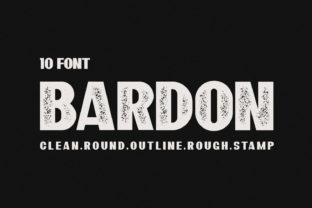
Bardon Family is a display typeface designed with intention—not just for legibility or novelty, but for presence. It occupies a thoughtful middle ground between classic serif gravitas and contemporary structural confidence. Unlike many display fonts that lean heavily into either ornate decoration or stark minimalism, Bardon Family balances proportion, contrast, and rhythm in a way that feels both grounded and distinctive. Its letterforms feature subtle bracketing, generous x-heights, and carefully modulated stroke endings—details that contribute to its bold yet approachable character.
What Sets Bardon Family Apart From Other Display Fonts
Display fonts serve a specific purpose: to command attention at larger sizes while reinforcing tone and identity. Within that category, Bardon Family distinguishes itself through consistency of voice across weights and widths. Many display families introduce dramatic stylistic shifts between light and black weights—sometimes sacrificing cohesion for contrast. Bardon Family maintains visual continuity, allowing designers to scale emphasis without disrupting hierarchy or mood.
Its uppercase letters carry architectural weight—clean verticals, restrained serifs, and balanced counters—while lowercase forms retain warmth and readability. This duality makes it unusually versatile for applications where tone must remain cohesive across formats: a headline on a print poster, a hero banner on a responsive website, or even a short typographic logo lockup.
Fitting Into Real-World Design Workflows
Choosing a display font isn’t just about aesthetics—it’s about integration. Bardon Family was built with practical use in mind. It includes a full range of OpenType features—small caps, discretionary ligatures, stylistic alternates—and supports extensive Latin-based language coverage. That means it can handle multilingual branding projects without requiring fallbacks or compromises.
It pairs well with neutral text faces—especially humanist sans-serifs like Lato, Inter, or Source Sans Pro—where its expressive character provides contrast without clashing. Unlike some high-contrast display fonts that struggle at smaller sizes or in low-resolution environments, Bardon Family retains clarity even when scaled down to 24–32px for subheadings or callouts. That adaptability matters in modern design systems, where typography must function across devices, screen densities, and editorial contexts.
Where Bardon Family Excels—and Where It Doesn’t
Bardon Family shines in contexts where authority, craftsmanship, or quiet confidence are central to the message. Think editorial mastheads, cultural institution branding, luxury product packaging, or long-form digital features where typographic personality supports narrative depth. Its strength lies in measured impact—not shouting, but holding space with intention.
That same restraint becomes a limitation in scenarios demanding high energy, playfulness, or extreme informality. For a youth-oriented app interface, a vibrant food truck menu, or a children’s book cover, Bardon Family may feel too composed—lacking the elasticity or whimsy other display options provide. Similarly, it’s not optimized for extended body copy; its design intent is emphatic, not ergonomic.
It also assumes a certain level of typographic awareness from the user. Because its character stems from subtlety—how terminals resolve, how spacing responds to weight changes—its effectiveness depends on careful implementation. Poor tracking, inconsistent sizing, or mismatched pairings can mute its strengths rather than amplify them.
Comparing Approaches: When to Choose Bardon Family Over Alternatives
Designers often weigh display fonts along two axes: expressive range and functional flexibility. Some fonts prioritize versatility—offering dozens of weights and widths, plus variable axes—but risk diluting their voice. Others double down on uniqueness, delivering strong personality at the cost of adaptability. Bardon Family sits closer to the latter, but with enough structural discipline to avoid feeling niche or brittle.
Compared to geometric slab serifs like Rockwell or Museo Slab, Bardon Family offers more organic modulation—its strokes breathe rather than lock into rigid geometry. Against high-contrast Didones like Bodoni or Playfair Display, it avoids the fragility that comes with ultra-thin hairlines, making it more resilient in digital environments and smaller-scale applications.
It also differs from many contemporary “neo-grotesque display” fonts that borrow from sans-serif logic but add exaggerated proportions or decorative quirks. Bardon Family doesn’t rely on novelty for distinction. Instead, it builds distinction through proportion, spacing, and considered detail—qualities that age well and resist trend fatigue.
Practical Considerations for Evaluation
Before committing to Bardon Family—or any display font—consider three practical dimensions:
- Contextual fit: Does the project demand immediate recognition, emotional resonance, or tonal consistency? Bardon Family supports all three—but only if the surrounding design reinforces rather than competes with its presence.
- Technical constraints: Will it be used in static PDFs, dynamic web environments, or embedded in native apps? Its OpenType support and web-friendly formats (WOFF2, variable options where available) make it viable across most modern delivery channels—but always test rendering at target sizes and resolutions.
- Production bandwidth: Does your team have time to refine kerning pairs, adjust line heights per weight, or explore alternate glyphs? Bardon Family rewards attention to detail. Using it out-of-the-box works, but unlocking its full potential requires deliberate application.
Real Examples of Effective Use
A regional museum recently adopted Bardon Family for its exhibition signage system. Rather than using it exclusively for titles, they applied its medium weight to descriptive captions—leveraging its clarity at 18pt on matte-finish vinyl. The result felt authoritative without being cold, and distinct from the sans-serif body type used in brochures.
Another example: a sustainable apparel brand used Bardon Family’s bold weight for its “Crafted With Care” campaign headline, then paired it with a modestly spaced, low-contrast sans for supporting text. The contrast communicated intentionality—not just in materials, but in communication.
In both cases, Bardon Family wasn’t chosen for novelty, but for alignment: its visual language matched organizational values—thoughtful, enduring, human-centered.
When Another Option Might Be More Appropriate
Bardon Family is not a universal solution. If your project prioritizes rapid iteration over refined execution—if you’re building a prototype, launching a time-sensitive campaign, or working within strict brand guidelines that already define a strong typographic system—then introducing a new display family may add complexity without proportional benefit.
Likewise, if your audience skews younger and responds more readily to informal, kinetic, or hand-drawn aesthetics, Bardon Family’s measured tone could feel misaligned. In those cases, exploring bolder, more gestural alternatives—or even custom lettering—may yield stronger connection.
Finally, budget and licensing matter. While Bardon Family is commercially available under standard desktop and web licenses, some users may find its pricing structure less flexible than subscription-based font services offering broader libraries. Evaluate not just what the font does, but how it fits into your broader resource allocation—time, tools, and permissions.
Making an Informed Choice
Selecting a display font is rarely about finding the “best” option—it’s about identifying the most appropriate one for a specific set of constraints, goals, and values. Bardon Family stands out for designers who value nuance over noise, longevity over trend, and clarity over clutter. It asks for thoughtful use, and in return, offers typographic integrity across touchpoints.
If your work involves branding, publishing, or experience design where typography carries meaning—not just information—Bardon Family merits close evaluation. But do so deliberately: test it alongside your existing type system, render it in real contexts, and assess how it behaves—not just how it looks. That kind of grounded, comparative evaluation is what leads to confident, lasting typographic decisions.