Hop Hop Bunny: A Whimsical Display Font That Fits Real Creative Workflows
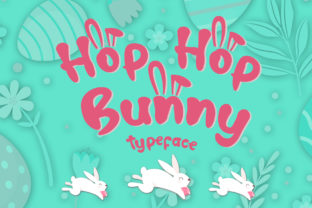
Hop Hop Bunny is a hand-drawn display font designed with playful bunny ears, bouncy letterforms, and gentle curves that evoke warmth, charm, and light-hearted energy. It’s not a utility font for body text or interfaces — it’s a purpose-built visual accent. Its value lies in how thoughtfully it integrates into real-world creative processes: from branding refinement and social campaign planning to classroom materials, product packaging, and personal project milestones. When used with intention, Hop Hop Bunny doesn’t distract — it directs attention, softens tone, and adds emotional resonance at precisely the right moment.
Where Hop Hop Bunny Fits in the Creative Process
Fonts are rarely chosen in isolation. They’re selected as part of a sequence: research → mood definition → asset alignment → execution → review. Hop Hop Bunny enters most naturally during the asset alignment phase — after core messaging is clarified but before final layouts lock in. For example, a small business owner designing a spring-themed newsletter might already know their offer, audience, and key visuals. What’s missing is the tonal bridge between those elements. That’s where Hop Hop Bunny helps: its whimsy reinforces playfulness without undermining credibility, especially when paired with a clean sans-serif for supporting text.
It’s also highly effective during review and iteration. When a team revisits mockups and senses something feels “off” — too formal, too sterile, or emotionally flat — swapping in Hop Hop Bunny for a headline or CTA button label can quickly test whether warmth is the missing ingredient. Because it’s a display font, it doesn’t require overhauling entire typographic systems — just one strategic substitution can shift perception meaningfully.
Using Hop Hop Bunny Before, During, and After Key Moments
Before a project: Use Hop Hop Bunny in early mood boards or client briefs to signal tone before design begins. A freelance illustrator pitching a children’s book concept might include a sample title treatment in Hop Hop Bunny alongside color swatches and sketch thumbnails — instantly communicating levity and approachability. This sets shared expectations early and reduces back-and-forth on voice.
During execution: Embed it selectively in live assets where emotional emphasis matters most. Think: the “You did it!” screen in a habit-tracking app, the header on a printable goal-planning worksheet, or the featured quote on an educator’s lesson slide. Because it’s legible at larger sizes but loses clarity below ~24px, it works best where space allows breathing room — not in tight UI labels or dense paragraphs.
After launch: Reuse Hop Hop Bunny consistently across touchpoints to reinforce brand personality over time. A bakery launching a new seasonal cupcake line might use it on the menu board, Instagram story highlight cover, and printed recipe card — each instance reinforcing the same joyful, handmade feeling. Consistency here isn’t about repetition for its own sake; it’s about building recognition through emotional continuity.
Compatibility and Pairing Strategy
Hop Hop Bunny thrives when paired intentionally — not arbitrarily. Its organic, slightly irregular rhythm means it balances best with typefaces that offer structure without stiffness. Sans-serifs like Inter, Poppins, or Lato provide clean contrast without competing. Serifs like Merriweather or Playfair Display work well too, as long as they’re set at a larger size or lighter weight to avoid visual tension.
Avoid pairing it with other highly decorative fonts, ultra-thin weights, or tightly spaced all-caps settings — those amplify clutter rather than charm. Also consider file format and platform constraints: Hop Hop Bunny is typically delivered as OTF or TTF. While modern browsers support it via @font-face, always test rendering on mobile devices and verify fallback behavior (e.g., using CSS font-display: swap). For print projects, embed it fully in PDFs or convert to outlines to prevent substitution.
Practical Implementation Tips
- Start with hierarchy: Use Hop Hop Bunny only for top-level elements — headlines, section titles, callouts, or short quotes. Never for navigation, captions, or data labels.
- Limit character count: Keep text blocks under 5–7 words. Longer phrases lose impact and reduce readability due to its expressive letter shapes.
- Test spacing rigorously: Kerning may need manual adjustment in design tools, especially around letters like “W”, “V”, and “A”. Don’t rely solely on auto-kerning.
- Check contrast: Its rounded forms soften edges, so ensure sufficient foreground/background contrast — especially against pastel or textured backgrounds.
- Respect context: It’s ideal for audiences open to warmth and personality — educators, wellness brands, indie publishers, craft businesses. Less suited for legal, financial, or enterprise B2B contexts unless deliberately subverting expectations.
Workflow Integration Examples
For marketers launching a limited-edition product: Hop Hop Bunny appears only on the hero banner image and email subject line (“Hop Into Spring! 🐇”). All supporting copy uses a neutral sans-serif. This creates immediate differentiation in crowded inboxes while maintaining scannability.
For educators preparing student-facing materials: A fifth-grade teacher uses Hop Hop Bunny for weekly “Challenge of the Week” headers on printable worksheets. Students recognize the font as a cue for fun, low-stakes learning — reinforcing motivation without changing lesson content or structure.
For freelancers refining their portfolio: Instead of using Hop Hop Bunny on every project thumbnail, a surface designer applies it only to case study titles where playfulness aligns with the client’s industry (e.g., a toy brand rebrand). This shows discernment — not decoration for decoration’s sake.
Long-Term Usability Considerations
Because Hop Hop Bunny carries strong personality, its longevity depends on disciplined usage — not frequency. Overuse dulls its effect and risks tonal fatigue. The most sustainable approach treats it like a signature gesture: deployed sparingly, with clear rationale, and always in service of user experience or message clarity.
Track how it performs: Does it increase engagement on social posts? Do clients respond more positively to proposals featuring it? Is it helping your audience remember your work more vividly? These aren’t vanity metrics — they’re signals of functional fit. If Hop Hop Bunny consistently supports your goals, keep refining how and where you apply it. If it doesn’t move the needle, pause and ask why — is the context wrong, the pairing off, or the expectation misaligned?
Also consider licensing. Hop Hop Bunny is often available under standard desktop or web licenses — but verify usage rights for commercial redistribution (e.g., if embedding in a SaaS dashboard or selling branded templates). Some versions include multilingual glyphs or stylistic alternates; explore those only if they serve a documented need — not just because they exist.
Final Thought: Intention Over Aesthetics
Hop Hop Bunny succeeds not because it’s cute — though it is — but because its cuteness is functional. Its bunny ears aren’t just ornamentation; they’re cognitive shorthand for lightness, curiosity, and approachability. When integrated with awareness of workflow timing, pairing logic, and audience context, it becomes a quiet but effective tool in your communication stack — one that helps people feel something before they even read a word.