Jonquil Sequent: Where Handmade Charm Meets Display Typography Power
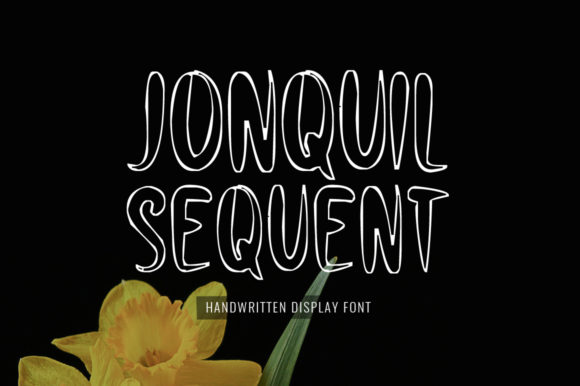
Typography isn’t just about legibility—it’s about voice, mood, and first impressions. When you need a font that stops scrolling, invites curiosity, and carries unmistakable character, Jonquil Sequent stands apart. It’s not another sleek sans-serif or a predictable serif revival. It’s a stunning outlined display font with a deliberate, human-made feel—like ink pulled through a nib, then traced with care and confidence.
A Font That Breathes With Imperfection
What makes Jonquil Sequent feel handmade isn’t randomness—it’s intention. Every curve has subtle variation. Each stroke ends with a gentle taper or a soft swell, never mechanical repetition. The outlines aren’t uniform; they widen and narrow like hand-drawn contours, giving letters depth and dimension even before color or shadow is added. This isn’t “rough” for the sake of trend—it’s expressive control. You see it most clearly in uppercase letters like A, M, and W, where the open forms invite light and space, while lowercase g, y, and q carry graceful, looping descenders that anchor the rhythm.
Unlike many display fonts that sacrifice readability at larger sizes, Jonquil Sequent maintains clarity without stiffness. Its generous x-height and open counters mean it remains legible even when scaled down to 48–60px—ideal for hero banners, app onboarding screens, or editorial pull quotes. But its true magic unfolds at scale: 120px and up, where the outline becomes architectural, almost sculptural.
Where Jonquil Sequent Fits in Real Projects
You won’t find Jonquil Sequent in body text—and it’s not meant to be there. Its strength lies in moments of emphasis, identity, and invitation. Think of it as your typographic handshake: bold, memorable, and warm.
- Branding & Logotypes: Restaurants, ceramic studios, botanical apothecaries, and independent bookshops use Jonquil Sequent to signal authenticity and craft. A café named “Hearth & Thyme” gains instant warmth when its logo appears in this font—no illustration needed. The outline allows for easy monochrome reproduction (think stamped menus or embossed business cards), while layered color versions pop on websites and social tiles.
- Digital Interfaces: Designers integrate Jonquil Sequent into landing pages not as background decoration—but as functional hierarchy. It replaces stocky all-caps headings with something more approachable yet distinctive. Paired with a clean, neutral sans-serif like Inter or Manrope for body copy, it creates contrast that guides attention without overwhelming.
- Print & Packaging: Because its outlines translate cleanly to vector formats, Jonquil Sequent scales flawlessly from tiny product tags to full-bag illustrations. One indie candle maker used it for scent names (“Bergamot + Rain”, “Sage & Smoke”) printed foil-debossed on kraft boxes—each word felt tactile, intentional, and quietly luxurious.
Why Designers Reach for Jonquil Sequent—Not Just Another Display Font
It’s easy to fall for novelty. But what keeps designers returning to Jonquil Sequent is how well it balances three often-competing traits: personality, versatility, and technical reliability.
Personality? Undeniable. But unlike some highly stylized fonts that limit pairing options, Jonquil Sequent works beautifully with both geometric and humanist typefaces. Its rhythm is relaxed—not frantic, not rigid—so it doesn’t clash with structured UI elements or data visualizations. And because it’s a single-weight, single-style family (no italics or condensed variants), it encourages thoughtful, restrained use—a feature, not a limitation.
Technically, it’s built for modern workflows. It includes standard OpenType features: ligatures for natural letter connections (especially helpful in words like “flow” or “outline”), stylistic alternates for customizing flair, and full Latin-1 support—including accented characters used across French, Spanish, Portuguese, and German. No surprises when localizing headlines or multilingual campaigns.
Pairing Jonquil Sequent Thoughtfully
Great typography is relational. Jonquil Sequent shines brightest when paired with restraint. Here’s what works—and why:
- Neutral Sans-Serifs: Try Jonquil Sequent with Inter, Poppins, or Work Sans. Their clean lines and consistent spacing create breathing room around its expressive outlines. Use the sans for navigation, captions, and CTAs—let Jonquil Sequent own the headline and subhead only.
- Soft Serifs (with caution): A low-contrast serif like Lora or Cormorant Garamond can complement Jonquil Sequent in editorial layouts—especially for literary magazines or artisanal newsletters. Avoid high-contrast serifs (think Didot or Bodoni); their sharpness competes rather than supports.
- Avoid: Other outlined, distressed, or heavily textured display fonts. Stacking decorative treatments dilutes impact. Also skip ultra-narrow or ultra-bold sans-serifs—they disrupt the organic flow Jonquil Sequent establishes.
Color matters too. Because the font relies on its outline, avoid placing it over busy backgrounds unless you add a subtle drop shadow or semi-opaque backdrop. On dark mode interfaces, a light stroke with a soft inner glow often reads better than pure white.
Practical Considerations Before You Commit
Before licensing Jonquil Sequent for a client project or brand system, consider these real-world factors:
- Licensing Scope: Check whether your intended use—web, desktop, app embedding, merchandise—is covered. Some licenses restrict redistribution (e.g., including the font in a SaaS platform users can download). Most reputable vendors offer clear tiered plans, including extended licenses for large-scale commercial use.
- Load Performance (Web Use): As a display font, Jonquil Sequent doesn’t need to load for every paragraph. Use
@font-facedeclarations withfont-display: swap, and serve only the WOFF2 format for modern browsers. It’s lightweight—typically under 40KB—so it won’t drag down page speed when used judiciously. - Accessibility Note: While highly legible at size, avoid using Jonquil Sequent for interactive elements like buttons or links that rely solely on visual styling. Always ensure sufficient contrast (at least 4.5:1 against background) and pair with accessible supporting type for interface text.
When Jonquil Sequent Might Not Be the Right Fit
That said, honesty matters. Jonquil Sequent isn’t ideal for every context. If your project demands:
- High-density information architecture (think dashboards or enterprise software),
- Strict corporate branding guidelines requiring strict typographic uniformity,
- Or frequent small-size usage (under 32px in UI labels or tables),
…then it’s wiser to reserve Jonquil Sequent for key brand moments—logos, campaign headers, signature graphics—while choosing more functional workhorses elsewhere.
Its power lies in scarcity. Used everywhere, it fades. Used with purpose, it resonates.
Final Thought: Typography as Intentional Gesture
In an age of algorithmic design systems and AI-generated visuals, Jonquil Sequent reminds us that typography still carries human gesture. That slight swell in the stem of a capital R, the gentle asymmetry in the crossbar of H, the confident pause at the end of a terminal—these aren’t flaws. They’re signatures. They say: This was made by someone who cared about how it feels to read, not just how it looks.
Whether you're naming a new product, redesigning a boutique website, or crafting a limited-edition poster series, Jonquil Sequent offers more than style. It offers sincerity—with structure, clarity, and quiet confidence. And in a crowded digital landscape, that kind of authenticity doesn’t just stand out—it lingers.