Skit Cut: Where Playful Typography Meets Purposeful Design
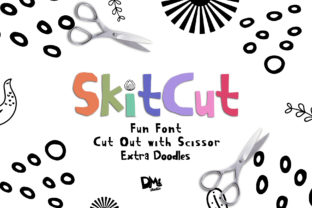
Typography isn’t just about legibility—it’s about tone, trust, and texture. In a digital landscape saturated with sleek sans-serifs and minimalist geometrics, Skit Cut arrives not as a rebellion, but as a refresh: a childish, quirky and fun font that carries real design weight. It doesn’t shout for attention; it skips into the frame, grinning, and invites viewers to lean in—not because it’s loud, but because it feels human, unhurried, and unapologetically joyful.
What Makes Skit Cut More Than Just “Cute”
Skit Cut is hand-drawn in spirit—its uneven baselines, slightly wobbly curves, and irregular stroke weights mimic the charm of marker-on-paper sketching. Yet it’s carefully engineered: every glyph maintains consistent spacing, kerning pairs are thoughtfully adjusted, and OpenType features support basic ligatures and stylistic alternates. That balance—between spontaneity and structure—is what gives Skit Cut its quiet authority. It’s not childish in the sense of being underdeveloped; it’s childlike: curious, expressive, and emotionally generous.
This distinction matters. Brands and creators increasingly recognize that authenticity isn’t found only in raw minimalism or polished realism—it lives in intentional imperfection. A café menu set in Skit Cut doesn’t signal amateurism; it signals warmth. A workshop flyer using Skit Cut doesn’t undermine credibility—it deepens connection. The font works precisely because it meets people where they are: tired of algorithmic perfection, hungry for moments of levity grounded in craft.
Why Whimsy Is Becoming a Strategic Choice
Consider how attention economies have shifted. Scrolling fatigue is real. Users now pause longer—not for louder visuals, but for those that feel *intentionally kind*. A 2023 Adobe Creative Trends report noted a 42% rise in projects using “expressive handwriting fonts” for brand voice development, especially among small businesses and independent educators. That’s not nostalgia—it’s responsiveness. When a parent sees Skit Cut on a children’s literacy app, they register care. When a freelancer uses it in a workshop title slide, participants subconsciously relax. The font cues psychological safety before a single word is read.
This aligns with broader lifestyle shifts: remote work has blurred professional/personal boundaries, and audiences respond better to voices that acknowledge complexity without sacrificing clarity. Skit Cut fits naturally into that space—not as a gimmick, but as punctuation. It says, “We’re serious about our work—and we don’t take ourselves too seriously.” That duality resonates across age groups: Gen Z values sincerity over polish; millennials appreciate nostalgic texture paired with modern utility; Gen X and older professionals often welcome visual relief from corporate sterility.
Where Skit Cut Fits Into Real-World Workflows
Designers aren’t just dropping Skit Cut into headlines and walking away. Its strength lies in thoughtful layering. For example:
- A local bookstore uses Skit Cut for event banners (“Storytime Saturday!”), while pairing it with a clean, highly readable sans-serif (like Inter or Lato) for body text—creating contrast that guides attention without confusing hierarchy.
- An online course creator sets module titles in Skit Cut but uses subtle letter-spacing (+40) and a light weight to preserve readability at smaller sizes on mobile devices.
- A nonprofit running a youth mental health campaign selects Skit Cut for quote graphics—not to infantilize, but to evoke openness and approachability, reinforcing their mission through form as well as content.
These aren’t decorative decisions. They’re accessibility-adjacent: Skit Cut’s friendly shape reduces cognitive load in emotionally charged contexts. It doesn’t replace functional typography—it complements it, adding emotional resonance where users need it most.
Evolving Beyond “Just for Kids”
Five years ago, playful fonts were largely siloed into birthday invitations or preschool newsletters. Today, Skit Cut appears on product packaging for sustainable skincare brands, embedded in SaaS onboarding flows, and even used by university extension programs targeting adult learners. Why? Because playfulness has matured. It’s no longer synonymous with immaturity—it’s recognized as a tool for lowering barriers, encouraging engagement, and signaling inclusivity.
This evolution mirrors larger creative trends: the rise of “soft professionalism,” where competence coexists with compassion; the growth of micro-brands built on personality rather than scale; and the increasing demand for design systems that reflect multidimensional identities. Skit Cut supports all of these—not as the sole voice, but as one authentic register among many.
Practical Tips for Using Skit Cut Well
Like any expressive typeface, Skit Cut rewards intentionality. Here’s what works—and what to avoid:
- Reserve it for moments that benefit from warmth. Use it for calls-to-action (“Grab Your Spot!”), section headers, quotes, or short labels—not long paragraphs or data tables.
- Pair deliberately. Contrast is key. Avoid other decorative or script fonts nearby. Instead, choose neutral, highly legible companions with strong x-heights and open counters.
- Test at actual size and context. Skit Cut’s charm can fade if rendered too small (<16px) or stretched across low-resolution displays. Preview on both desktop and mobile before finalizing.
- Consider licensing and format. Ensure your version supports web use (WOFF2), includes Latin Extended-A characters if needed for multilingual projects, and allows commercial redistribution if you’re building templates for clients.
- Don’t force whimsy where it doesn’t belong. A legal disclaimer or financial report isn’t the place—unless irony is part of a deliberate, well-signaled brand strategy.
Not a Trend—A Texture With Staying Power
Skit Cut isn’t riding a viral wave destined to crash. It’s responding to something quieter but more durable: the human need for variation, vulnerability, and visual kindness in an increasingly automated world. You won’t see it dominating Fortune 500 annual reports—but you will see it growing in spaces where relationships matter more than reach: community newsletters, indie publishing, educator resources, therapy practice websites, and small-batch product branding.
That’s where its relevance deepens. As AI-generated visuals become commonplace, hand-inflected typefaces like Skit Cut gain new meaning—not as relics of analog craft, but as deliberate markers of human presence. They say, “A person chose this. A person made this. A person wants you to feel something specific here.”
And that, ultimately, is why Skit Cut endures: not because it’s trendy, but because it’s truthful. It doesn’t hide behind neutrality. It offers a smile—not forced, not generic, but earned through careful design and clear purpose. In a time when so much communication feels transactional, Skit Cut reminds us that even typography can be an act of generosity.
Getting Started Without Overthinking It
You don’t need a full rebrand to try Skit Cut. Start small: swap out the heading font on your next blog post intro, redesign one email subject line for your newsletter, or add it to a single social graphic highlighting a lighthearted team milestone. Notice how it changes the mood—not dramatically, but perceptibly. Does it make the message feel more inviting? More memorable? More like you?
If yes, that’s your cue—not to overhaul everything, but to keep exploring where that feeling serves your goals. Typography isn’t about rules. It’s about resonance. And sometimes, the most professional choice you can make is to let your work breathe, giggle, and wink—just once—in Skit Cut.