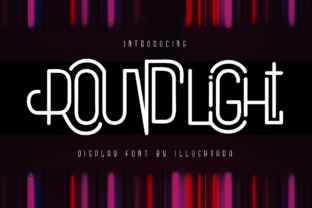
Round Light: A Disco-Era Display Font That Delivers
Round Light isn’t just another retro font—it’s a deliberate, joyful nod to the tactile warmth of 1970s disco signage, reimagined with clean precision for today’s digital and print environments. Designed with soft curves, balanced spacing, and subtle bounce in its letterforms, it avoids caricature while preserving unmistakable personality. Its charm lies in how effortlessly it bridges nostalgia and modern usability—no gimmicks, no overdesign, just confident, friendly presence.
Why Designers Reach for Round Light First
It solves real problems. When you need a headline, logo lockup, or social banner that feels energetic but not chaotic, Round Light delivers clarity without stiffness. Unlike many display fonts that sacrifice legibility for flair, Round Light maintains strong x-height, open counters (like in ‘a’, ‘e’, and ‘s’), and consistent stroke weight—making it surprisingly readable even at smaller sizes on screens or in tight layouts.
Its playful nature doesn’t mean it’s frivolous. In fact, its restraint is what makes it versatile: the rounded terminals aren’t exaggerated; the contrast between thick and thin strokes is gentle, not dramatic. That means it pairs thoughtfully with neutral sans-serifs like Inter, Lato, or even classic Georgia—giving designers room to build hierarchy without visual shouting.
Creative Uses That Go Beyond the Obvious
Think beyond “disco party flyer.” Round Light shines where warmth, approachability, and lightness matter—especially when competing with overly polished or sterile alternatives.
- Brand identity for lifestyle and wellness businesses: A yoga studio, ceramic workshop, or small-batch tea brand can use Round Light in logos or packaging headers to signal friendliness and human-scale craftsmanship—without leaning into clichéd “handwritten” tropes.
- Educational materials for younger audiences or adult learners: Teachers and course creators use it in slide titles, workbook covers, or newsletter banners to soften academic tone while keeping content organized and scannable.
- Digital product UI elements: Not for body text—but perfect for call-to-action buttons (“Get Started”, “Join Us”), feature highlights, or playful empty-state illustrations in SaaS dashboards aimed at creative professionals.
- Small business signage and merch: Screen-printed tote bags, café chalkboard menus, or local event posters benefit from its tactile rhythm—especially when printed at medium scale where its curves read as intentional, not fuzzy.
How Different Users Adapt It Effectively
Freelancers and marketers often test Round Light in A/B headlines for email subject lines or landing page banners. Because it conveys optimism without sounding salesy, it frequently lifts CTR in campaigns targeting curious, values-driven audiences—think eco-product launches or community workshops.
Bloggers and educators apply it selectively: one bold headline per post, never more than two font weights in a single layout. They avoid stacking it with other decorative fonts, instead anchoring it with a clear, highly legible paragraph typeface. This keeps focus where it belongs—on the idea, not the ornament.
Small business owners appreciate how Round Light scales across touchpoints. A bakery might use it for its Instagram story highlight icons, menu headers, and loyalty card design—all while maintaining cohesion. The key? Consistent sizing, color, and spacing. One brand guideline note they often add: “Use only uppercase for logos and all-caps for short phrases; lowercase works well for friendly subheads.”
Practical Tips for Stronger Results
Round Light thrives when treated with intention—not excess. Here’s how to keep it effective:
- Respect its role. It’s a display font—not meant for paragraphs, captions, or data tables. If your audience needs to scan quickly or read deeply, pair it with a proven text face and let Round Light introduce, not explain.
- Control contrast carefully. On dark backgrounds, use mid-tone colors (not pure white) to soften glare. On light backgrounds, avoid pale yellows or pastels that reduce readability. Testing on mobile screens is non-negotiable.
- Limit weight variation. Round Light includes Light, Regular, and Bold—but mixing all three in one layout can dilute impact. Most successful uses stick to two weights max, reserving Bold for primary emphasis only.
- Align with audience expectations. A fintech startup testing Round Light in a dashboard prototype found users associated it with “friendly support,” not “serious analytics.” That insight led them to use it only in help-center headers—not financial charts. Context shapes perception.
Real Projects, Real Outcomes
A Portland-based indie bookstore launched a summer reading challenge using Round Light for weekly poster headers and Instagram carousel titles. Their goal wasn’t nostalgia—it was signaling that reading could be joyful, communal, and unpretentious. Engagement rose 22% on campaign posts, with comments referencing “the warm, inviting feel” of the visuals.
Another example: a freelance illustrator built her entire portfolio site around Round Light for section headers and project titles—paired with a crisp, low-contrast serif for case study text. Clients told her the site felt “confident but kind”—a rare and valuable impression in a crowded creative field.
What ties these together isn’t just aesthetics. It’s how Round Light supports voice and values—helping creators communicate *who they are*, not just *what they do*.
Getting Started—Without Overthinking
You don’t need a full branding system to begin. Try this: pick one recurring communication need—like workshop announcements, podcast episode titles, or product feature cards—and apply Round Light there for two weeks. Note how people respond. Does it make your message feel more accessible? Does it align with how you want to be perceived?
If yes, expand deliberately. If not, pause and ask why—not to discard the font, but to refine your intent. Maybe the color’s off. Maybe the pairing needs adjustment. Maybe it’s stronger in uppercase only. Iteration, not inspiration, is where Round Light earns its keep.
At its best, Round Light reminds us that functional design doesn’t have to be neutral—and expressive design doesn’t have to be loud. It’s proof that thoughtful detail, rooted in real cultural texture, can still serve real work—today.