Sayone: A Vintage-Industrial Display Font for Intentional Visual Communication
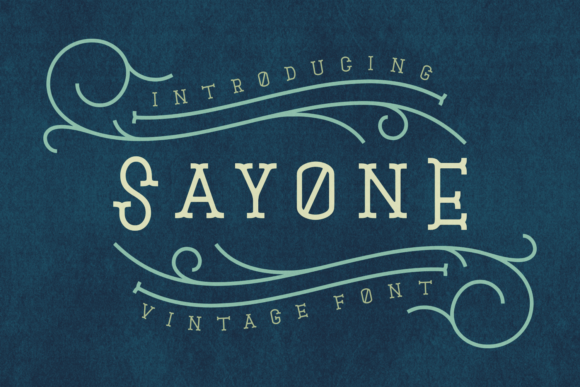
Sayone is a display font that balances delicacy with structural presence—its letterforms carry the quiet confidence of hand-set metal type, softened by subtle irregularities and a gentle contrast between thick and thin strokes. It’s not designed for body text or rapid scanning. Instead, Sayone excels where attention is invited, not demanded: headlines, logos, packaging, editorial features, signage, and digital banners. Its vintage-industrial character isn’t nostalgic decoration—it’s functional texture that signals craft, authenticity, and considered design.
Where Sayone Fits in Your Creative or Business Workflow
Think of Sayone as a strategic pause in your visual process—not the first tool you reach for, but the one you select deliberately after defining tone, audience, and context. It rarely belongs in early wireframes or rough mockups. Instead, it enters during refinement: when brand voice has been clarified, when hierarchy is locked, and when visual distinction matters more than speed or scalability.
For marketers launching a limited-edition product line, Sayone might appear only on the hero banner and product label—not across email templates or social thumbnails. For educators designing a workshop handout, it could anchor the title page and section dividers, reinforcing thematic cohesion without compromising readability elsewhere. For small business owners updating their storefront signage, Sayone works best when paired with a neutral sans-serif for supporting text—creating contrast that guides the eye without competing for meaning.
Integration Before, During, and After Execution
Before implementation: Audit your existing assets. Does your current typography system already include a strong display option? If so, ask whether Sayone adds unique value—or simply duplicates function. Test its legibility at intended sizes (e.g., 48pt for web banners, 120pt for print posters) and in real environments (backlit screens, matte paper, weathered wood signage). Confirm licensing covers your use case—especially if deploying via web fonts, embedded PDFs, or physical merchandise.
During execution: Prioritize pairing. Sayone gains clarity and purpose when anchored by a highly legible companion face—like Inter, Lora, or even Helvetica Neue. Avoid stacking multiple decorative fonts; Sayone’s personality is strongest when it’s the sole expressive element. In Figma or Adobe XD, create reusable text styles with preset tracking (+20–40 units for uppercase, +10–20 for title case) to maintain rhythm across layouts. Export SVGs—not PNGs—for scalable logo use, preserving crisp edges at any size.
After launch: Monitor performance qualitatively. Does Sayone reinforce your intended impression—artisanal, grounded, thoughtful—or does it unintentionally read as dated or overly ornate? Gather feedback from users outside your immediate team: a teacher, a retail associate, a freelance developer. Their unfiltered reaction often reveals whether the font supports comprehension—or distracts from it.
Practical Pairing and Compatibility Considerations
Sayone performs reliably across modern platforms—but consistency depends on preparation. When embedding via @font-face, serve WOFF2 for browsers and include fallbacks (e.g., font-family: "Sayone", "Playfair Display", serif;). On iOS and Android, test rendering at smaller display sizes: while Sayone shines at 36pt+, it may lose nuance below 24pt in UI elements. For print, export as vector-based EPS or PDF/X-4 to preserve hinting and spacing integrity.
It integrates cleanly with common tools: Figma auto-hints Sayone when installed locally; Adobe Creative Cloud recognizes OpenType features like discretionary ligatures (if enabled); Canva supports it as an uploaded font (though variable weight options won’t apply unless manually adjusted). No plugin or extension is required—but do disable browser font smoothing (-webkit-font-smoothing: antialiased;) for crisper web rendering on macOS.
Workflow Examples Across Roles
- Freelance designers: Use Sayone in pitch decks only on the cover slide and project title frames—never in service descriptions or timelines. This trains clients to associate the font with vision, not logistics.
- Educators: Apply Sayone to course module titles in LMS dashboards (e.g., Canvas or Moodle), then switch to system fonts for instructions and deadlines. The contrast subtly reinforces learning milestones without sacrificing accessibility.
- Small business owners: Print Sayone on receipt tape headers or shelf tags—paired with a clean sans-serif for pricing—to elevate perceived value without redesigning entire POS systems.
- Bloggers: Reserve Sayone for newsletter subject lines and featured post headers. Avoid using it in RSS feeds or email clients that don’t support custom fonts—fallback to Georgia or Times New Roman maintains tone continuity.
Long-Term Usability and Quality Control
A font like Sayone gains strength through restraint. Overuse dilutes its impact and risks visual fatigue. Establish internal guidelines: maximum two weights (Regular and Bold), no italic variants unless explicitly designed into the family, and strict limits on all-caps usage (tracking must increase by at least 30 units to avoid crowding).
Build quality control into your asset management. Tag Sayone files clearly (“Sayone-Regular-Web.woff2”, “Sayone-Bold-Print.otf”) and document usage rules in your brand handbook—even if informal. Revisit those rules every 6–12 months: does Sayone still reflect how your audience perceives you? Has your content strategy shifted toward faster-paced formats where its deliberate pace now feels misaligned?
Also consider sustainability. Sayone’s industrial roots mean it pairs well with tactile materials—recycled paper, brushed aluminum, linen-textured fabric. If your brand uses physical touchpoints, choose substrates that complement, not compete with, its character. A glossy laminate over Sayone-printed stationery can mute its warmth; uncoated stock lets its texture breathe.
Making the Decision Practical, Not Just Aesthetic
Selecting Sayone shouldn’t be about loving its look in isolation. It’s about asking: Does this font help people understand what matters—and why it matters—more clearly than alternatives? That question shifts focus from decoration to function. It invites comparison: How does Sayone perform against similar display fonts like Bebas Neue (more rigid), Grand Hotel (more theatrical), or Cinzel (more classical)? The answer lies in context—not aesthetics alone.
Implementation isn’t about installing and applying. It’s about aligning typographic intent with audience expectation. A tech startup using Sayone on its homepage might signal craftsmanship—but only if its product experience delivers on that promise. A café using it on chalkboard menus reinforces local identity—if the interior and service match that warmth. Sayone doesn’t create meaning. It amplifies meaning already present in your offering, environment, or message.
So before adding Sayone to your next project, pause. Review your goals. Check your constraints. Then apply it where it earns its place—not where it merely fits.