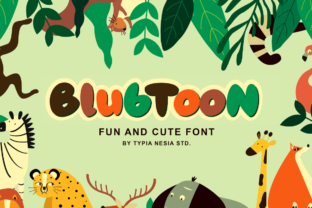
Blubtoon: A Whimsical Handwritten Font with Heart
Blubtoon isn’t just another script font—it’s a playful, hand-drawn typeface that feels like it was sketched by a joyful friend over coffee. Every curve has bounce, every loop breathes personality, and each character carries warmth without sacrificing legibility. Designed with natural irregularity—slight variations in stroke weight, gentle wobbles, and soft terminals—it avoids the stiffness of digitized scripts while staying crisp and readable at medium to large sizes.
Why Blubtoon Resonates Across Different Goals
What makes Blubtoon special isn’t universal appeal—it’s how meaningfully it serves distinct needs. A teacher planning a classroom poster doesn’t need the same features as a freelance designer crafting a wedding invitation or a small-batch soap maker labeling artisanal products. Blubtoon meets people where they are—not with one-size-fits-all promises, but with quiet adaptability.
For Beginners & Hobbyists: Friendly First Steps into Typography
If you’ve ever hesitated before picking a font—wondering whether it’ll look “too childish” or “not professional enough”—Blubtoon lowers that mental barrier. Its charm is approachable, not intimidating. You don’t need design training to sense when it fits: a birthday card for your niece, a chalkboard-style menu for your weekend farmers’ market stall, or a cozy Instagram story announcing your new pottery class.
Beginners often prioritize ease of use and instant visual payoff. Blubtoon delivers both: install it once, type normally, and watch your text soften and smile. No ligatures to learn, no stylistic alternates to toggle—just friendly, consistent letterforms that work out of the box.
For Educators & Content Creators: Warmth That Builds Connection
In learning environments—whether in-person or digital—tone matters as much as content. Blubtoon helps educators signal openness and approachability. Think of a printable worksheet titled “Let’s Explore Rainforests!” where the font gently invites curiosity instead of demanding attention. Or a newsletter from a homeschool co-op that feels handwritten and human—not templated and distant.
Educators also care about accessibility: Blubtoon’s clear letter shapes (like its open ‘a’, distinct ‘g’, and unambiguous ‘1’) support early readers better than highly stylized scripts. It’s not a replacement for dyslexia-friendly fonts—but used thoughtfully in headings or decorative elements, it adds joy without compromising clarity.
For Small Business Owners & Makers: Brand Personality Without Complexity
When you’re running a solo business—baking custom cakes, stitching embroidery kits, or designing greeting cards—you’re not hiring a full branding agency. You need tools that reflect your voice *now*, not after six months of research. Blubtoon offers instant brand texture: soft but confident, handmade but polished.
A candlemaker might use Blubtoon for jar labels (“Lavender + Lemon Zest”) alongside a clean sans-serif body font—creating contrast that feels intentional, not accidental. A children’s book illustrator could pair it with watercolor textures for chapter titles, reinforcing narrative tone before a single word is read.
Here, priorities shift toward commercial usability and visual cohesion. Blubtoon includes standard OpenType features (basic Latin characters, numerals, punctuation), works reliably across platforms (Mac, Windows, Canva, Adobe apps), and licenses clearly permit commercial use—including physical products and digital downloads—so there’s no last-minute licensing panic before launching your Etsy shop.
For Design Professionals & Freelancers: A Deliberate Accent, Not a Crutch
Experienced designers rarely reach for whimsical fonts first—and that’s why Blubtoon stands out. It’s not meant to carry entire interfaces or long paragraphs. Instead, it excels as a strategic accent: a headline that stops scrolling, a call-to-action button that feels personal, or a logo lockup where friendliness is part of the message.
Professionals appreciate its intentionality. Unlike some handwritten fonts that rely on randomness or excessive swashes, Blubtoon balances expressiveness with restraint. Its lowercase ‘y’ and ‘j’ have subtle tails—not dramatic flourishes—so it scales gracefully from mobile banners to large-format prints. And because it’s well-kerned and evenly spaced, it saves time during layout refinement.
Where Blubtoon Fits—and Where It Doesn’t
It’s okay if Blubtoon isn’t right for your project. It won’t replace a robust text font for a 50-page report. It’s not built for ultra-narrow columns or tiny UI labels. And if your brand voice leans into sharp minimalism, high-tech precision, or formal elegance, Blubtoon’s warmth may feel misaligned.
Ask yourself:
- Is this for a moment of connection? (e.g., a welcome email, workshop handout, product tag)
- Does legibility at larger sizes matter more than microscopic detail?
- Do you want typography that supports emotion—not just information?
If two or more answers are “yes,” Blubtoon is worth trying. If your priority is multilingual support, extensive language coverage, or variable font axes (like weight or width sliders), other options may serve you better.
Real Projects, Real Uses
Here’s how people actually use Blubtoon—no hypotheticals:
- A blogging educator uses it for section headers in printable PDF resources—making academic content feel less daunting to middle-school learners.
- A freelance event planner pairs it with a neutral serif for wedding programs, letting the couple’s names shine while keeping the rest elegant and readable.
- A podcast host applies it to social media quote graphics—turning thoughtful soundbites into shareable moments that feel authentically human.
- A nonprofit fundraiser chooses it for handwritten-style thank-you notes mailed to donors, reinforcing sincerity in an increasingly automated world.
No one is using Blubtoon to typeset legal disclaimers or code documentation—and that’s the point. Its strength lies in specificity, not universality.
Getting Started Thoughtfully
You don’t need special software to begin. Blubtoon works in free tools like Google Slides and Canva, as well as professional suites like Illustrator and Affinity Designer. Preview it first: type a short phrase, try it at 36pt and 72pt, and see how it holds up next to your existing fonts.
Consider your workflow, too. If you collaborate with others, confirm everyone has access—or embed it properly in PDFs and exports. If you’re building a website, test how it renders across devices; while webfont versions exist, desktop use remains its sweet spot for optimal control and quality.
Most importantly: let Blubtoon respond to your intent—not the other way around. Its whimsy isn’t decoration. It’s quiet confidence in kindness, clarity in playfulness, and craft in simplicity.