Hugos: A Handwritten Font with Dark Charm for Standout Creative Projects
When you're designing a logo, crafting a book cover, or building a brand identity that needs to feel human, expressive, and memorable—typography isn’t just decoration. It’s voice, mood, and first impression—all in one. That’s where Hugos steps in: a distinctive handwritten font with a dark, personal twist. It’s not just playful—it’s intentional. Not just quirky—it’s emotionally resonant. And not just decorative—it’s deeply functional for creatives who want authenticity without sacrificing impact.
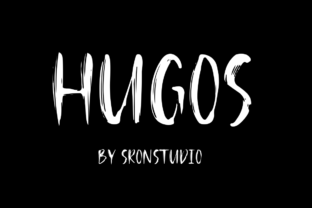
Many designers and content creators face the same quiet challenge: finding type that feels genuinely hand-drawn but still holds up across formats—whether printed on vinyl, scaled for mobile banners, or embedded in email campaigns. Generic script fonts often fall flat: too stiff, too saccharine, or too fragile at small sizes. Others lack personality—or worse, feel overused. That’s why so many turn to Hugos. Its uneven baseline, subtle ink bleeds, and slightly off-kilter letterforms give it an organic, lived-in quality—like something written late at night with a favorite pen. Yet it remains highly legible and versatile enough for real-world use.
Why Hugos Fits Real Creative Needs
Hugos was built for people who value emotional texture in their design work—not just visual polish. It answers practical needs:
- Standing out in saturated markets — Whether you’re launching an indie podcast, an art zine, or a boutique skincare line, Hugos adds immediate distinction. Its dark charm avoids cliché while still feeling accessible.
- Conveying intimacy without sounding childish — Unlike overly cutesy scripts, Hugos balances warmth and edge. It’s perfect for projects that explore complex themes: mental health journals, true crime newsletters, poetic chapbooks, or moody fashion branding.
- Working reliably across platforms — Hugos includes OpenType features like ligatures and alternate characters, giving you control over rhythm and expression. It renders cleanly in web-safe environments (with proper embedding), supports multilingual Latin-based languages, and scales well from headlines down to caption size—when used thoughtfully.
Practical Ways to Use Hugos Effectively
How you apply Hugos matters more than how much you use it. Here’s how experienced designers integrate it meaningfully:
Pair it wisely
Hugos shines brightest when contrasted—not crowded. Try pairing it with a clean, neutral sans-serif like Inter, Poppins, or even Helvetica Neue. This combination gives your layout breathing room: Hugos handles emotion and emphasis; the supporting font delivers clarity and structure. Avoid pairing it with other decorative or script fonts—that dilutes its uniqueness and risks visual noise.
Reserve it for high-impact moments
Use Hugos where personality matters most: headlines, short quotes, signature lines, or logo wordmarks. For body copy, stick with highly readable fonts—Hugos isn’t designed for long-form reading. Think of it as your creative accent color: powerful in moderation, overwhelming in excess.
Leverage its expressive details
Take advantage of Hugos’s built-in alternates. The lowercase “a”, “g”, and “y” each have two distinct forms—one standard, one more stylized. Swapping in an alternate can subtly shift tone: more rebellious, more tender, more mysterious. In design tools like Adobe Illustrator or Figma, enable OpenType features to access these variations easily.
Who Benefits Most—and How They Use It Differently
Different users approach Hugos with different goals—and that shapes how they implement it:
- Authors and self-publishers use Hugos for chapter titles, epigraphs, or limited-run paperback covers. One romance novelist uses it only for handwritten-style love letters included as bonus content—making those pages feel like intimate artifacts, not just text.
- Branding designers apply Hugos selectively in mood boards and early identity concepts to signal tone before finalizing logotypes. Its dark charm helps clients quickly grasp whether a brand should feel introspective, bold, or quietly defiant.
- Social media creators incorporate Hugos into quote graphics and story highlights—especially for reflective, artistic, or therapeutic content. Because it loads fast and renders crisply on mobile, it performs well even in compressed formats.
- Printmakers and illustrators layer Hugos directly onto screen-printed posters or zines. Its imperfect rhythm complements handmade textures, reinforcing a cohesive analog aesthetic—even when produced digitally.
Things to Keep in Mind Before You Start
While Hugos is flexible, thoughtful implementation ensures it enhances—not undermines—your message:
- Legibility thresholds matter: At sizes under 16px, some characters (like the lowercase “e” or “s”) may lose clarity. Always test readability on actual devices—not just in design software.
- Color choices affect tone: Black or deep charcoal maximizes Hugos’s dark charm. But try deep burgundy, forest green, or slate blue for nuanced alternatives. Avoid overly bright or neon colors—they clash with its grounded sensibility.
- Licensing is straightforward—but verify: Hugos is available for personal and commercial use, but always confirm the license covers your specific use case—especially if you’re embedding it in apps, SaaS platforms, or client deliverables.
- It’s not for every brand: If your project demands corporate neutrality, technical precision, or universal accessibility (e.g., government health resources), Hugos likely isn’t the right fit. Respect its character—and your audience’s expectations.
Turning Creative Vision Into Clear Results
At its core, Hugos isn’t about trendiness. It’s about resonance. When your goal is to make someone pause, lean in, and feel something—curiosity, nostalgia, recognition—Hugos gives you a tool rooted in humanity, not algorithms. It doesn’t shout. It whispers with intention. And in a world flooded with AI-generated sameness, that kind of authenticity is rare—and valuable.
Start small: redesign one social post using Hugos for the headline only. Add it to your next presentation title slide. Sketch a logo concept around its rhythm. Let it guide tone before you finalize color or imagery. You’ll quickly notice how its twisted charm clarifies intent—not just decorates it.
Because great typography doesn’t just look good. It helps people understand, remember, and connect. And with Hugos, that connection feels earned—not engineered.