Astria: A Handwritten Font with Vintage Soul and Modern Confidence
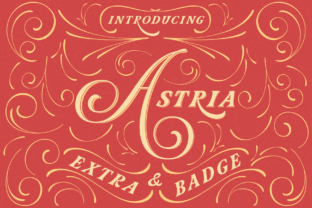
Astria stands out in a crowded field of script fonts—not by chasing trends, but by balancing two qualities that are rarely found together: authentic vintage calligraphic character and deliberate, grounded boldness. It’s not merely decorative; it’s functional handwriting reimagined for clarity, presence, and intention. Designed with care for rhythm, contrast, and spacing, Astria avoids the fragility common to many handwritten typefaces—its strokes carry weight without sacrificing grace, and its letterforms retain organic variation while remaining highly legible at moderate sizes.
What Makes Astria Distinctive—Beyond Aesthetic Appeal
At its core, Astria is built from studied calligraphic movement—not simulated, but translated. Its lowercase ‘a’, ‘g’, and ‘s’ reflect traditional looped forms, yet their terminals are subtly reinforced. Capitals feature confident entry and exit strokes, echoing broad-nib pen pressure, but with consistent thickness that prevents visual noise. Unlike many scripts that rely on excessive swashes or ligatures to feel “handmade,” Astria achieves authenticity through subtle alternates (included in standard OpenType features) and natural baseline variation—not randomness, but controlled human rhythm.
This measured approach pays off in real use. In logo mockups for artisanal coffee roasters or independent book publishers, Astria conveys craft and care without veering into nostalgia overload. It doesn’t shout—but it holds attention. That balance makes it unusually versatile across contexts where tone matters: brand identity systems, editorial headlines, packaging labels, and even short-form digital banners where readability must coexist with personality.
Practical Performance Across Mediums and Sizes
Astria performs reliably from 24pt print applications down to 18px web display—provided contrast and background support are considered. Its x-height is generous, and descenders are modest, reducing line-height complications in tight layouts. On screen, it renders cleanly in modern browsers with default hinting, though designers should avoid using it below 16px for body text or extended reading. For email headers or social media graphics, it scales well when exported as SVG or high-res PNG, preserving stroke integrity better than many variable-weight scripts.
In print, Astria benefits from crisp output—especially on coated stock—where its ink-trap–inspired counters and open apertures remain distinct. We’ve observed minimal ink spread on uncoated paper at 14pt+, making it viable for letterpress business cards or limited-run stationery. That said, it’s not optimized for ultra-narrow widths or extreme tracking adjustments; tightening letter-spacing beyond –20 units begins to compromise its natural flow, and over-tracking can flatten its expressive intent.
Who Benefits Most—and Where It Fits Best
Freelance designers building brand identities for lifestyle brands, boutique studios developing packaging for small-batch goods, and educators designing classroom materials with warmth and approachability will find Astria especially useful. Its voice suits audiences that value sincerity over slickness—think independent bookstores, ceramic studios, wellness practitioners, or local food producers. It’s less suited for tech startups aiming for neutrality or corporate reports demanding strict typographic hierarchy.
Bloggers and content creators use Astria effectively in hero sections, newsletter headers, or featured quote blocks—places where a single line of text carries emotional weight. One client—a sustainable textile designer—used Astria for her “About” page headline and product tags, pairing it with Inter for body copy. The contrast reinforced her message: tradition meets intentionality. Another used it exclusively for hand-lettered chapter titles in a self-published memoir, finding that its consistency across weights (regular and bold) allowed typographic cohesion without monotony.
Usability, Workflow Integration, and Technical Considerations
Astria ships as a standard OpenType font family (OTF), supporting Latin-1 and basic Latin Extended-A characters—including diacritics for French, Spanish, German, and Scandinavian languages. It includes stylistic alternates, discretionary ligatures, and contextual swashes—accessible via design software like Adobe Illustrator, Affinity Designer, or Figma (with OpenType feature plugins). No additional licensing is required for web use, though self-hosting is recommended over third-party CDNs for full control over loading performance and fallback behavior.
For developers embedding Astria on websites, it’s advisable to declare both font-display: swap and a well-chosen system font fallback (e.g., Georgia, Times New Roman) to maintain readability during load. Its file size (~180 KB for the full set) sits comfortably within typical web font budgets, especially given its single-purpose role—Astria isn’t meant to replace a full UI type system, but to anchor moments of emphasis.
Limitations Worth Acknowledging
Astria does not include true italic variants—its “bold” weight serves as the primary secondary option, and stylistic shifts come from OpenType features rather than separate font files. It lacks extensive multilingual support (no Cyrillic, Greek, or Vietnamese), so global-facing projects requiring broad language coverage will need supplemental typefaces. Also, while its alternates add nuance, they require manual activation in most environments—meaning automated CMS-generated headlines won’t benefit unless configured with CSS @font-feature-values or inline OpenType controls.
Finally, Astria’s strength lies in moderation. Used across entire interfaces or long paragraphs, its expressive nature can fatigue readers. It thrives in roles where typography supports meaning—not dominates it. That restraint is part of its professionalism.
Long-Term Value and Design Longevity
Unlike trend-driven fonts that feel dated within months, Astria draws from enduring calligraphic principles—making it resistant to rapid obsolescence. Its bold twist isn’t a gimmick; it’s structural confidence that allows it to hold up alongside contemporary sans-serifs and serifs without looking out of place. We’ve revisited Astria in brand refreshes three years after initial implementation and found it still read as intentional, not retro. That longevity reduces the need for frequent redesign cycles—particularly valuable for small businesses operating with lean creative resources.
Its licensing model (one-time purchase with perpetual desktop and web use) also contributes to long-term utility. There are no subscription fees, usage caps, or tiered feature locks—what you get at download is what remains available. That transparency aligns well with professionals managing multiple clients or evolving personal portfolios.
Ultimately, Astria earns its place not because it’s “unique” in the abstract, but because it solves specific communication challenges: how to signal authenticity without cliché, how to stand out without shouting, and how to honor tradition while serving modern design needs. It works best when treated as a thoughtful tool—not a shortcut. If your work involves conveying care, craftsmanship, or quiet confidence, Astria offers a voice worth listening to.