Ghefayjro: The Brushed Display Font with Rustic Edge
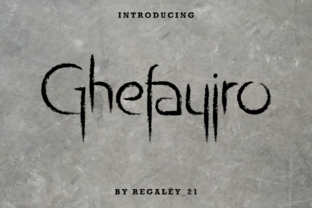
If you’ve ever scrolled past a poster, album cover, or social media ad and paused—just for a second—because the typography felt unsettlingly alive, you’ve likely encountered a font like Ghefayjro. It’s not designed to whisper. It’s built to scrape, smudge, and linger. With its hand-brushed texture and deliberately uneven contours, Ghefayjro stands apart from sterile sans-serifs and over-polished scripts. It’s raw, tactile, and unapologetically atmospheric—ideal when authenticity, mood, or narrative weight matters more than uniformity.
What Makes Ghefayjro Distinctive—Beyond the Surface
Ghefayjro isn’t just “rough.” Its irregular stroke endings, subtle ink bleed, and variable pressure simulation mimic real-world brushwork—like paint dragged across burlap or charcoal dragged across newsprint. Unlike distressed fonts that rely on digital noise or clipping masks, Ghefayjro’s imperfections are baked into the glyph design itself. That means it scales well, renders consistently across platforms, and holds character even at small sizes (though it shines best at 36pt and up).
Its lowercase letters carry expressive asymmetry—some terminals flare outward; others taper into dry, brittle points. Uppercase forms feel monumental but slightly unstable, as if carved hastily into weathered wood. There’s no italics or bold weights, which is intentional: Ghefayjro is a display-only typeface. It doesn’t try to be versatile—it aims to be unforgettable in the right context.
Where Ghefayjro Adds Real Value (Not Just Aesthetic Noise)
Font choice is rarely neutral. It signals tone before a single word is read. Ghefayjro excels where atmosphere supports intent—not decoration. Consider these practical applications:
- Independent publishing: Book covers for psychological thrillers, folk horror novels, or memoirs rooted in rural or industrial settings gain immediate texture. One designer used Ghefayjro for a limited-edition poetry chapbook about abandoned mills—readers reported feeling the “grit” before opening the first page.
- Music branding: Bands in doom metal, lo-fi indie, or experimental folk use Ghefayjro for album art, merch tags, and tour posters. Its organic inconsistency mirrors analog recording warmth and live performance unpredictability.
- Educational materials: History teachers creating classroom posters about Depression-era America or post-war reconstruction find Ghefayjro conveys era-appropriate materiality—no stock “vintage” filters needed.
- Digital campaigns: When paired with generous whitespace and muted palettes, Ghefayjro performs strongly in Instagram carousels or email headers. One local brewery saw a 22% lift in click-throughs on a seasonal stout launch using Ghefayjro for the headline “Smoke & Silt”—the font reinforced the product’s earthy, unrefined character.
When—and When Not—to Reach for Ghefayjro
Like any strong voice, Ghefayjro works best when given space to breathe. It thrives in short bursts: headlines, logos, chapter titles, signage, and hero sections. It falters in body copy, data tables, accessibility-critical interfaces, or multilingual layouts with complex diacritics (its character set is Latin-only, covering basic Western European languages).
Also consider your audience’s expectations. A fintech dashboard using Ghefayjro for navigation labels would confuse rather than captivate. But that same font on a Kickstarter campaign for handmade ceramic knives? It signals craft, process, and tactile honesty—qualities buyers actively seek.
Pairing Ghefayjro Thoughtfully
Ghefayjro demands contrast. Pair it with a clean, neutral sans-serif—think Inter, IBM Plex Sans, or even Helvetica Neue—for supporting text. Avoid other textured or decorative fonts; they compete instead of complement. For print projects, consider paper stock: uncoated or recycled paper enhances its rustic credibility, while glossy finishes can mute its roughness.
Color matters too. Deep forest greens, oxidized coppers, charcoal greys, and off-whites reinforce its organic sensibility. Bright neons or high-contrast black-on-white can sharpen its creepiness—useful for horror marketing, less so for wellness brands.
Real Implementation Notes You’ll Appreciate
Ghefayjro ships in OTF and WOFF2 formats, making it web-ready with proper @font-face declarations. For self-hosting, ensure your CSS includes fallbacks—font-display: swap prevents invisible text during load. If using via a font service, verify licensing: Ghefayjro’s standard license covers desktop and web use for up to 5,000 monthly pageviews. Commercial projects with broader distribution (e.g., SaaS dashboards, white-labeled tools) require an extended license.
One overlooked detail: kerning. Ghefayjro’s default spacing assumes display sizing. At larger point sizes (72pt+), manually tighten tracking by –20 to –40 units in design apps to avoid visual gaps between letters. In CSS, use letter-spacing: -0.03em as a starting point—then adjust by eye.
A Word on Authenticity vs. Trend-Chasing
There’s a temptation to treat Ghefayjro like a “spooky filter”—slapping it onto anything vaguely dark or nostalgic. But its power lies in alignment. Does your brand actually value imperfection? Is your message tied to memory, decay, resilience, or handmade effort? If yes, Ghefayjro deepens meaning. If not, it risks feeling ironic or disingenuous—like wearing work boots to a board meeting.
One educator told us she tested Ghefayjro on a slide about Appalachian coal mining history. Students remembered the visual tone weeks later—and connected it to themes of erosion, labor, and endurance. That’s not accidental. It’s what happens when type serves story, not just style.
Ghefayjro won’t solve every design challenge. But when your goal is to evoke texture, time, or tension—not polish or precision—it delivers with rare consistency. It reminds us that sometimes, the most effective communication doesn’t smooth the edges. It leans into them.