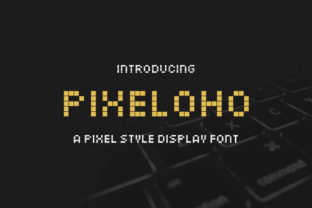
Pixeloho: A Modern Pixel Font with Minimalist Cool
If you’ve ever scrolled past a retro-futuristic website, a sleek indie game UI, or a designer’s portfolio that somehow feels both nostalgic and utterly fresh—you’ve likely sensed the quiet power of pixel-perfect typography. Pixeloho isn’t just another pixel font. It’s a carefully balanced synthesis of digital heritage and contemporary clarity: a modern and minimalist pixel style font with an incredibly cool vibe. And it works precisely because it doesn’t try to be everything—it commits to its voice, then delivers it with consistency and intention.
Why Pixel Typography Still Matters—Especially Now
In an age of variable fonts, AI-generated visuals, and ultra-smooth rendering, choosing a pixel font might seem counterintuitive. But context changes meaning. Pixeloho thrives where authenticity, intentionality, and visual rhythm matter more than photorealism. Think of it like using a manual film camera in 2024—not because it’s “better,” but because it shapes how you see, edit, and communicate.
Unlike early pixel fonts built for technical constraints (like limited screen resolution), Pixeloho was designed for today’s high-DPI displays and diverse creative workflows. Its spacing is tuned for readability at 16–48px, its proportions avoid visual fatigue, and its minimalism eliminates decorative noise—so your message stays centered, not crowded.
Where Pixeloho Fits Naturally—and Where It Doesn’t
Pixeloho shines brightest in environments where tone, identity, and subtle contrast do heavy lifting:
- Branding for tech-adjacent startups—especially those rooted in gaming, coding education, or digital art tools. A logo set in Pixeloho signals approachability without sacrificing precision.
- UI microcopy in desktop apps or web dashboards—where buttons, status labels, or tooltips benefit from instant recognition and spatial economy.
- Editorial design for newsletters or zines—particularly those exploring internet culture, generative art, or analog-digital hybrids. Its rhythm supports scannability without feeling clinical.
- Physical merch and signage—like enamel pins, stickers, or laser-cut acrylic displays—where clean geometry translates reliably across materials.
It’s less ideal for long-form body text, legal disclaimers, or accessibility-critical interfaces where maximum legibility at small sizes is non-negotiable. That’s not a flaw—it’s alignment. Pixeloho prioritizes expressive utility over universal coverage, and that focus makes it unusually reliable within its lane.
Real Workflow Benefits—Not Just Aesthetics
Designers and developers often overlook how much time typography decisions cost—not just in selection, but in iteration. With Pixeloho, many common friction points dissolve:
Because its character set includes full Latin-1 support, standard punctuation, numerals, and common symbols (including arrows, brackets, and basic math operators), you’re rarely forced into workarounds—no swapping fonts mid-layout, no hunting for alternate glyphs. Its monospaced sibling variant also allows for seamless pairing in code snippets or terminal-style displays, reducing the need for multiple type families.
For marketers building landing pages or social assets, Pixeloho’s strong visual identity means fewer rounds of “make it pop” feedback. Its inherent contrast and structure hold up across backgrounds—light, dark, textured, or gradient—without requiring heavy outlines or shadows. That translates directly to faster asset production and more consistent cross-platform expression.
Creative Confidence, Not Just Consistency
Here’s what experienced creators quietly appreciate: Pixeloho doesn’t force interpretation. Its minimalism isn’t empty—it’s curated. Each glyph has intentional weight distribution, consistent stroke contrast, and balanced negative space. That means when you use it, you’re not leaning on trendiness; you’re leveraging craft.
A freelance educator designing a workshop on computational creativity might use Pixeloho for slide headers—not to shout “retro!” but to visually echo the logic, constraint, and elegance of early programming environments. A small business owner launching a modular furniture line could apply it to packaging tags, subtly reinforcing themes of precision, assembly, and human-scale design.
That kind of resonance doesn’t come from arbitrary styling. It comes from a typeface built with awareness—not just of pixels, but of how people read, remember, and respond to visual cues in context.
Practical Tips for Getting Started
You don’t need to overhaul your entire system to test Pixeloho’s fit. Try these low-commitment approaches:
- Swap one headline per project. Replace a generic sans-serif hero title with Pixeloho at 32–48px. Adjust letter-spacing slightly (+20–40 units) to honor its rhythm—not to “fix” it, but to let its spacing breathe.
- Use it for data visualization labels. In charts or infographics, Pixeloho’s uniform width and crisp edges help anchor numbers and categories without competing with bars or lines.
- Pair intentionally—not automatically. Avoid stacking it with other highly stylized fonts. Instead, combine it with a neutral, highly legible sans-serif (like Inter, Manrope, or even system-ui) for body text. The contrast becomes functional, not decorative.
And if you’re embedding it on the web: serve it as a WOFF2 file with `font-display: swap`—it loads quickly, and its small filesize (under 24KB for the full set) won’t drag down performance metrics.
Who Benefits Most—and Why It’s Worth Their Time
Pixeloho serves professionals who value clarity of intent over volume of options. That includes:
- Frontend developers building internal tools or developer-facing products—where UI cohesion and typographic reliability reduce cognitive load for users and maintainers alike.
- Indie game studios needing cohesive UI fonts that reflect gameplay tone without licensing complexity or rendering hiccups across platforms.
- Educators and workshop facilitators whose materials live at the intersection of tech literacy and creative expression—and who want typography that reinforces, rather than distracts from, core ideas.
- Small creative studios balancing brand distinctiveness with production efficiency—where one well-chosen font can unify websites, pitch decks, and social assets without feeling repetitive.
It’s not about chasing novelty. It’s about selecting a tool that quietly amplifies your goals—whether that’s helping learners grasp abstract concepts, guiding users through complex software, or distinguishing your product in a saturated market.
A Final Thought: Typography as Quiet Strategy
In a world of algorithmic feeds and attention economies, the most effective design choices are often the ones that feel inevitable—not flashy, not forced, but *right*. Pixeloho succeeds because it meets a specific need with integrity: it gives digital interfaces and creative projects a grounded, human-scaled voice—one that nods to history without living in it.
It won’t solve every typographic challenge. But for the right project, at the right moment, it removes ambiguity. It saves time. It strengthens message-to-medium alignment. And sometimes, that’s the coolest vibe of all.