MiddleWoman: A Bold, Hand-Cut Font for Expressive Headlines and Analog-Inspired Design
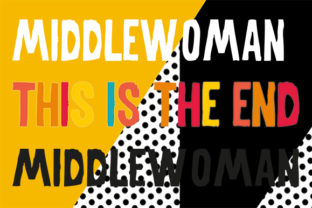
MiddleWoman is a chunky, hand-cut display font designed to evoke the tactile energy of physical collage—think thick paper cutouts, inked edges, and intentional imperfection. It’s not a digitized version of handwriting or a stylized serif; it’s built from the ground up to feel like something you’d find in a well-loved scrapbook, a zine cover, or a vintage concert poster. Its weight is generous, its letterforms are slightly irregular, and its rhythm leans into asymmetry—not as a flaw, but as a feature.
What Sets MiddleWoman Apart From Other Display Fonts
Many bold display fonts prioritize uniformity, scalability, or digital precision. MiddleWoman does the opposite: it embraces variation. Letters shift subtly in width and baseline alignment; terminals taper with visible “cut” marks; some characters include slight overlaps or softened corners that mimic hand-scissored paper. That intentionality makes it functionally distinct—not just visually, but behaviorally. It doesn’t recede into background text or blend into layouts. It commands attention, but without shouting. It’s bold, yes—but also warm, approachable, and quietly confident.
This isn’t a font for body copy, captions, or interfaces requiring high legibility at small sizes. It’s built for moments where tone matters as much as message: album art, event posters, book covers, packaging accents, or editorial headlines that anchor a visual narrative. Its strength lies in contextual resonance—not versatility.
Fitting MiddleWoman Into Real Design Workflows
Because MiddleWoman is a display face, its integration depends heavily on pairing and hierarchy. In practice, designers often pair it with clean, neutral sans-serifs (like Inter, Poppins, or even system fonts) to create contrast that feels intentional rather than jarring. The juxtaposition works because MiddleWoman brings texture and personality, while the supporting typeface provides clarity and breathing room.
For example, a local bakery launching a seasonal menu might use MiddleWoman for the headline “SUMMER HARVEST SPECIALS” above a short list set in a light-weight sans-serif. The font reinforces craft, authenticity, and handmade care—without needing illustration or photography to carry the same weight. Similarly, a nonprofit organizing a community storytelling project could use MiddleWoman on printed postcards or social banners to signal warmth and human scale, distinguishing itself from more corporate or institutional typography.
It’s also highly effective in motion graphics and print where resolution supports its detail—especially at sizes 48pt and larger. At smaller sizes (below 32pt), some of its expressive nuances begin to blur, and legibility drops noticeably in complex words or tight tracking. That’s not a shortcoming—it’s a design constraint worth acknowledging early.
When MiddleWoman Fits—and When It Doesn’t
MiddleWoman shines in projects where authenticity, tactility, or nostalgic resonance are strategic goals. It’s especially strong when the audience values craft, individuality, or analog sensibilities—think indie publishers, boutique studios, educators creating classroom materials with personality, or artists building cohesive visual identities around physical artifacts.
Conversely, it’s less suitable for contexts demanding neutrality, scalability across devices, or strict brand consistency. Government websites, financial dashboards, multilingual interfaces, or apps with dense information architecture generally benefit from more restrained, tested, and internationally legible typefaces. MiddleWoman’s stylistic emphasis also means it carries cultural associations—its scrapbook aesthetic may unintentionally signal “casual,” “nostalgic,” or “feminine-coded” depending on context and audience perception. That’s not inherently limiting, but it does require thoughtful alignment with voice and values.
Comparing Approaches: Style, Function, and Alternatives
Designers evaluating MiddleWoman often consider alternatives along two axes: visual style and functional scope. On the style side, fonts like Bangers, Changa One, or Permanent Marker share its boldness and informal energy—but they lean more toward comic-book exuberance or marker-drawn spontaneity. MiddleWoman feels quieter, more deliberate, and materially grounded. It’s less about speed or exaggeration and more about presence and texture.
On the functional side, many designers reach for variable fonts or superfamily systems (e.g., fonts with extensive weights, widths, and optical sizes) when they need flexibility across formats. MiddleWoman isn’t built for that. It’s a focused tool—not a system. That tradeoff is meaningful: choosing MiddleWoman means accepting narrower application boundaries in exchange for stronger tonal specificity.
Some users explore hand-lettered custom solutions instead of licensed fonts like MiddleWoman. That route offers total uniqueness but demands time, skill, and budget—plus ongoing consistency across iterations. MiddleWoman delivers a professional, production-ready interpretation of that hand-cut aesthetic without requiring illustration expertise.
Practical Considerations for Implementation
- Licensing: MiddleWoman is typically offered under standard desktop and web licenses. Always verify usage rights for your specific medium—especially for embedded PDFs, mobile apps, or SaaS platforms.
- File Formats: Most versions include OTF and WOFF2, making it viable for both print and modern web use. Be mindful of file size if deploying widely on low-bandwidth sites.
- Language Support: It covers basic Latin characters (A–Z, numerals, common punctuation) but lacks extended diacritics or non-Latin scripts. Projects requiring multilingual support will need fallback strategies.
- Accessibility: As with most display fonts, MiddleWoman shouldn’t be used for UI labels, form fields, or navigation links. Reserve it for headings and decorative elements where semantic HTML and sufficient contrast can still support screen readers and low-vision users.
Making an Informed Choice
Selecting a font like MiddleWoman isn’t just about liking how it looks—it’s about whether its qualities align with what your project needs to communicate and how it will be experienced. Ask yourself:
- Is the primary goal to establish mood, identity, or emotional resonance—or to convey dense, neutral information?
- Will this appear mostly in large-format print, static digital banners, or responsive layouts where scaling matters?
- Does the audience respond positively to tactile, imperfect, or nostalgic cues—or do they expect polish, precision, or global familiarity?
- Do you have the design bandwidth to pair it thoughtfully—or would a more self-contained, versatile type system reduce decision fatigue?
There’s no universal “best” font—only better fits. MiddleWoman excels when fit is narrow but deep: when a project benefits from the quiet confidence of something hand-made, when boldness needs warmth, and when typography is part of the story—not just its container.
If you’re weighing options for a headline-heavy campaign, a limited-run publication, or branding that celebrates materiality over minimalism, MiddleWoman deserves serious consideration—not as a default, but as a deliberate choice. And if your needs point elsewhere—toward adaptability, translation, accessibility-first delivery, or technical neutrality—that’s equally valid. The strongest design decisions come from clarity about purpose, not preference alone.