Selectric Light
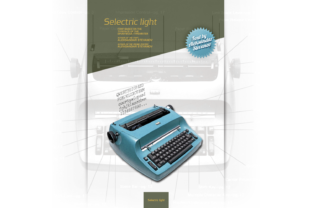
Selectric Light is a digital typeface designed to evoke the distinctive visual character of the IBM Selectric typewriter—a mechanical writing instrument widely used from the 1960s through the 1980s. It is not a direct digitization of original typewriter output, but rather a carefully crafted interpretation that captures key stylistic traits: subtle irregularities in letterform weight, slight variations in character spacing, and the soft, slightly rounded terminals reminiscent of carbon-impact printing on paper. As a “retro-looking idiosyncratic typewriter font,” Selectric Light prioritizes personality and historical resonance over technical uniformity.
Why Designers Consider Selectric Light
Designers often seek fonts that support narrative intent—not just legibility or neutrality, but tone and context. Selectric Light appeals most strongly when the goal involves signaling authenticity, nostalgia, or analog craftsmanship. It may be relevant for projects such as independent publishing, editorial features on mid-century design, artisanal branding, or interface elements where users benefit from a deliberate departure from sleek, algorithmically optimized UI typography.
Its appeal is situational rather than universal. Users drawn to Selectric Light typically value expressive typography as a functional layer—not merely decoration—but one that reinforces message, audience, and medium. It’s less about “vintage for vintage’s sake” and more about aligning typographic voice with conceptual intent.
Benefits of Using Selectric Light
Selectric Light offers several practical advantages in appropriate contexts:
- Distinctive identity: Its irregular baseline alignment, gentle stroke contrast, and softened corners differentiate it from both monospaced digital fonts and generic serif/sans-serif families.
- Readability at moderate sizes: Unlike many highly distressed typewriter fonts, Selectric Light avoids excessive noise—its letterforms remain legible in body text at 14–18px and perform well in headings up to 36px.
- Web-friendly rendering: The font includes OpenType features and has been optimized for cross-browser consistency, with careful attention to hinting and vertical metrics—making it more reliable than older typewriter-style fonts that rely on bitmap fallbacks.
- Licensed for broad use: Available under standard desktop and web font licenses, it supports commercial implementation without requiring custom development or embedding workarounds.
Tradeoffs and Realistic Expectations
Selectric Light is intentionally imperfect—and that imperfection carries consequences. Its uneven rhythm and reduced x-height mean it performs poorly in dense, long-form text blocks or low-resolution environments. It is not suitable for accessibility-critical interfaces (e.g., government forms or medical instructions), where consistent character recognition and screen reader compatibility are paramount.
Also, while its design nods to mechanical origins, it does not replicate true monospacing. Characters retain proportional widths, which improves readability but reduces the strict grid-like predictability expected in coding environments or data tables. Users anticipating typewriter-style alignment across columns or line breaks should test carefully—or consider alternatives explicitly built for monospaced fidelity.
Another consideration: Selectric Light lacks extensive language support beyond basic Latin characters. It includes diacritics for Western European languages but does not cover Cyrillic, Greek, or extended Unicode ranges. Projects requiring multilingual typesetting will need supplemental fonts or fallback strategies.
When Selectric Light Is a Strong Fit
Selectric Light excels in focused, intentional applications:
- Editorial design: Magazine spreads or blog headers where tone matters more than scanning speed—e.g., profiles of analog photographers, essays on pre-digital typography, or cultural retrospectives.
- Branding for niche products: Small-batch coffee roasters, letterpress studios, or notebook manufacturers seeking visual continuity between physical packaging and digital presence.
- Interactive storytelling: Web-based narratives or museum exhibits where typography contributes to immersive context—paired with restrained color palettes and ample whitespace.
- Print collateral with tactile emphasis: Business cards, posters, or zines printed on textured stock, where the font’s soft edges complement physical grain rather than compete with it.
When Alternatives May Be More Appropriate
Selectric Light is not a default choice—and that’s by design. Consider other options if your project requires:
- Strict monospacing: Fonts like IBM Plex Mono, Fira Code, or Source Code Pro offer typewriter-inspired structure with full technical rigor for development environments or tabular data.
- Broad language coverage: PT Mono or Cutive Mono provide monospaced clarity with expanded Unicode support, better suited for international documentation or multilingual websites.
- Higher legibility at small sizes: For footnotes, captions, or mobile UI labels, even lightly styled sans-serifs like Inter or Roboto deliver more consistent recognition under variable viewing conditions.
- Greater stylistic flexibility: If you need multiple weights, italics, or optical sizing, families like FF Meta Serif or Proxima Nova offer richer typographic hierarchies without sacrificing warmth or character.
Making an Informed Choice
Evaluating Selectric Light isn’t about determining whether it’s “good” or “bad”—it’s about assessing alignment. Ask yourself:
- What is the primary function of the text? If clarity, speed, or compliance drives the decision, Selectric Light likely falls outside optimal parameters.
- Who is the intended audience? A younger demographic unfamiliar with mechanical typewriters may read the style as quaint or arbitrary—whereas designers or educators working with analog history may recognize and appreciate its cues.
- How much visual real estate does the type occupy? It works best when given breathing room—avoid cramming it into tight navigation bars or stacked form fields.
- Does the rest of the typographic system support it? Pairing Selectric Light with a neutral, highly legible secondary font (e.g., Lora for body copy or Open Sans for UI labels) creates balance without diluting its impact.
Testing is essential. Render Selectric Light in actual layout conditions—not just isolated specimens. Check contrast ratios against background colors, preview on multiple devices, and assess how it behaves alongside icons, images, and interactive elements. Because its strength lies in contextual resonance, its success depends less on isolated metrics and more on holistic integration.
In summary, Selectric Light serves a specific, narrow role: enhancing meaning through evocative form. It rewards thoughtful application and loses effectiveness when deployed generically. For designers who prioritize intentionality over convenience—and who understand that typography communicates before it conveys—Selectric Light remains a quietly compelling option among contemporary display fonts.